
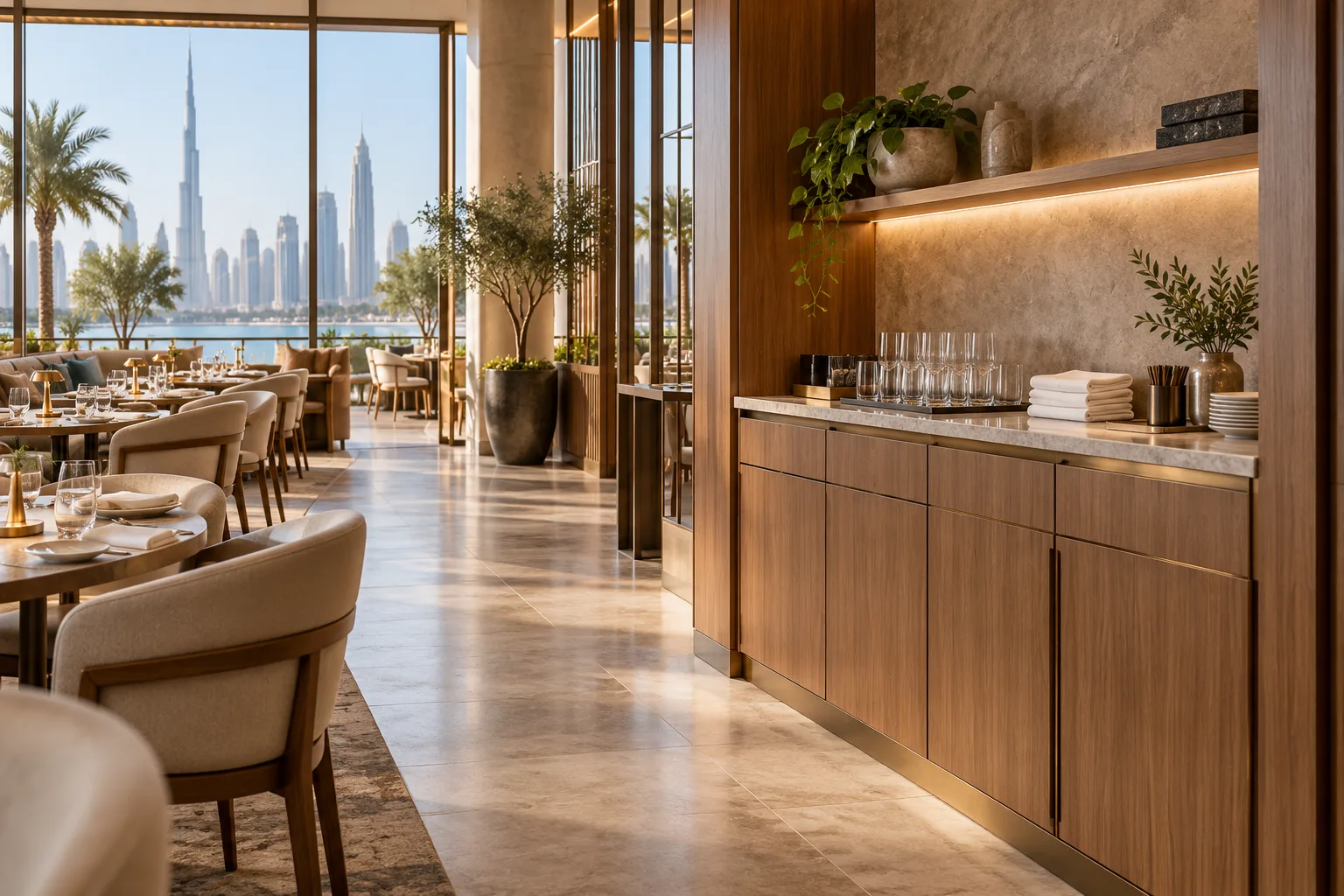
Restaurant interior design concept. Illustrative setting for the planning discussion.
Trace the full payment journey and confirm the equipment, counter and supplier interfaces with the operator and its responsible providers.
A restaurant's payment device seems like a small operational purchase until staff need to use it during a busy service. A server waits for a terminal at the bar, another crosses the entrance to print a bill, and a guest who wants to pay at the table is directed towards the host desk. The interior may look complete while the payment journey has never been planned.
Before fixing counters and connection positions for a restaurant fit-out in Dubai, map how a bill is requested, prepared, presented, paid and closed within the operator's chosen system. This article concerns the physical workflow and fit-out interfaces. Payment processing, device compatibility, information security and legal requirements belong with the operator and its appropriate providers. A designer should not invent those requirements or promise that a generic counter will satisfy them.
Explore CBD’s restaurant interior design and fit-out service for the main project scope.
Jump to a section 13 topics
Describe the service model first
Ask the operator where guests are expected to pay. A table-service restaurant, a counter-order café and a venue serving several zones can have different arrangements. Include exceptions the operator actually intends to support, such as a guest settling a bill while another person remains at the table. Avoid starting with a location for the terminal before the payment process has been described.
Write the sequence in ordinary tasks and identify the responsible role at each step. The design team does not need live guest details or payment credentials to understand the work. An anonymous example bill and the device supplier's physical information can be enough to explain the interface. The purpose is to translate the operating model into locations, movement and equipment requirements, not to design the restaurant's financial controls.
Follow the server through one complete payment
Trace a staff member responding to a payment request from a representative table. Where is the bill prepared? Does the server need to collect a device, print something or obtain assistance? Where does the device return afterwards? The journey can involve several locations even when the guest experiences a single short interaction.
Repeat the route from tables in different parts of the restaurant. A location convenient to the main dining room may be awkward for another zone. Record where the route crosses food service, the host position or guest circulation. This creates evidence for comparing payment-point locations. It should not be converted into an unsupported universal distance or staffing rule; the arrangement must suit the actual premises, system and service model.
Confirm the selected equipment and accessories
Request the physical requirements from the operator's payment and point-of-sale providers. Depending on the arrangement, the project may need to coordinate terminals, charging equipment, printers, displays or other accessories. Identify the selected models and relevant connection information. A generic device symbol does not establish power, data, mounting, charging or operational compatibility.
Ask the responsible specialist to confirm what is supplied as part of its package and what the fit-out team must provide. Record the boundary between fixed construction, furniture, equipment installation and configuration. Where a technical requirement is unresolved, identify who will confirm it before the relevant work is released. The designer's drawing can coordinate those inputs; it should not be mistaken for the provider's technical acceptance of the system.
Allocate a usable staff task area
A payment position may need more than the footprint of a device. Staff may handle a bill folder, receipt roll, guest query or other operator-defined task. Ask the team to demonstrate the intended process with representative objects on a proposed surface. Include the positions of cables, charging accessories and any storage required under the operator's procedures.
Check what happens when another staff member needs the same position. A narrow counter that works for one demonstration may become difficult during overlapping requests. The solution may involve a different layout, another defined task position or an operating change. Do not automatically increase counter length without understanding the bottleneck. The investor needs to know which problem the additional construction is intended to solve.
Separate payment from unrelated counter functions
Bars, host desks and waiter stations already support their own tasks. If the operator wants to place payment equipment there, review the combined use rather than assuming spare surface is permanently available. A bill printer can compete with drinks preparation, reservations information or the storage of service items. The design should identify those conflicts before the joinery detail is approved.
Follow the busiest realistic overlap. A guest asks a question at the host desk while a server needs a device; another team member returns equipment for charging. Ask where each person stands and what remains accessible. The operator should decide how responsibilities are allocated. The interior team can compare physical arrangements that support that decision, while keeping the counter's intended customer experience and staff tasks understandable.
Consider the guest's complete route
Some guests may approach a payment position directly under the operator's service model. Trace their route from the table and onward to the exit, including anyone accompanying them. Ask whether waiting or a brief discussion would obstruct another activity. The relevant appointed team should review accessibility and other applicable requirements for the actual project.
The aim is to avoid an unintended queue becoming part of a circulation route because the layout considered only the counter itself. If guests normally remain seated, test the staff journey instead and identify the exceptions. Do not make the fit-out depend on every guest behaving in the same way. A practical design brief records the intended process and how the operator wishes to handle foreseeable alternatives.
Review views and handling positions
Ask the operator and its appropriate providers what information-handling requirements affect the layout. The designer can review screen orientation, the location of documents and views from nearby seats without receiving real payment records. Use blank or fictional information for demonstrations. Do not circulate card details, account credentials or live guest information in a general fit-out brief.
A simple view check can reveal that a staff display faces a waiting guest or that a receipt surface sits within easy view from an adjacent table. The appropriate response should be developed with the operator's requirements in mind. These design observations support the wider process; they are not a certification of payment security, compliance with a technical standard or the adequacy of the restaurant's financial procedures.
Plan charging, storage and reset
Where portable devices are part of the chosen system, ask the responsible provider and operator to describe charging and storage requirements. Identify the equipment, connection locations and the point at which an item returns to its intended position. A device that is continually borrowed from another zone can create operational difficulties even when enough units were purchased on paper.
Show the physical arrangement on the relevant furniture and services drawings once the specialist information is confirmed. Consider access for replacement and routine maintenance under the supplier's instructions. Avoid sealing equipment into joinery that cannot be accessed conveniently, or using a decorative niche whose dimensions were never checked against the actual accessory. The fit-out detail should support the confirmed equipment rather than dictate an unverified technical solution.
Test more than one payment at a time
Use a short rehearsal based on a plausible service period. Several tables request their bills while normal food service continues. Staff demonstrate the chosen process with props and the proposed equipment positions. Record where they wait, cross another route or need to borrow a surface. Include the return and reset steps, which are easily missed when the exercise stops at the guest interaction.
The rehearsal can identify a physical constraint, a device-availability assumption or a staffing issue. Those are different findings. Ask the appropriate team to assess the response before changing the design. More joinery will not necessarily solve a system configuration problem, and another device will not automatically correct a blocked route. The value is a shared understanding of the cause and a proportionate decision before fabrication.
Coordinate the payment package with the programme
Identify when selected equipment information is needed for counters, outlets and other fixed interfaces. The interior team may be able to progress some work while configuration remains with the operator's provider, but the physical requirements that affect fabrication should be resolved at the appropriate stage. Mark assumptions if information is still provisional.
If a model changes during procurement, compare the actual dimensions, mounting and connection implications before accepting the replacement into the drawing issue. A commercially equivalent product can still need a different physical arrangement. Record who confirms compatibility and who revises the dependent works. This prevents the site team from discovering a supplier change only when a delivered device does not fit its intended position.
Keep approval and operating responsibilities clear
Payment equipment is one part of a restaurant interior and operation. The applicable design, property and authority requirements should be assessed for the actual premises and proposed works. An operational walkthrough does not approve the layout or authorise opening. Dubai Municipality publishes food-establishment guidance, and the appointed team should confirm the relevant project requirements without treating this article as a substitute for them.
The operator's payment and technology providers retain the responsibilities agreed in their appointments. CBD Projects can coordinate the interior details and fit-out interfaces within its scope, but it does not claim to issue payment-system compliance certificates or configure every provider's equipment. A clear responsibility record helps the investor understand which work is included and which specialist actions remain before the chosen process can operate.
Price the interfaces consistently
When seeking construction quotations, provide the same equipment and task information to each bidder. Identify client-supplied devices, fixed furniture, relevant service provisions and any specialist installation boundary. Ask for assumptions and exclusions to be stated against that information. A low counter allowance may omit accessories or connections that another provider has included.
When comparing fit-out companies in Dubai, assess the complete physical arrangement rather than the appearance of the counter alone. Separate the interior construction price from equipment supply, configuration and other operator-appointed services. Where a requirement remains unknown, identify the information needed to resolve it. The owner can then make a more informed investment decision without relying on an unexplained promise that the restaurant will be ready for any payment method.
Prepare an anonymous payment-flow brief
Bring the floor plan, intended service model, representative equipment information and an anonymous task sequence to the first design meeting. Identify the provider roles and any known operating constraints. There is no need to include real guest bills, banking information or live credentials. A clear description of the physical steps is more useful to the design team than sensitive financial data.
CBD's free initial consultation can help establish the interior coordination scope and the decisions still needed from the operator and providers. The resulting project proposal should identify the actual works and responsibilities. The concept imagery accompanying this article illustrates a restaurant interior; it is not evidence of a completed CBD payment installation, a named client's operating process or measured improvements to transaction time.
Related reading: Restaurant Waiter Stations in Dubai: Reduce Cross-Traffic During Service.
Frequently asked questions
Should the terminal always be at the bar?
No universal location follows from the equipment type. Review the service model, staff routes, equipment requirements and the bar's other tasks. A location that works in one restaurant may create conflicts in another. Ask the operator and relevant providers to confirm the process, then compare physical arrangements against that brief and the actual premises.
Can payment equipment be chosen after counter manufacture?
Some selections may remain open, but identify the dimensions and interfaces that affect fixed construction before release. Ask the responsible provider which requirements must be confirmed and what assumptions are acceptable. A late change can affect the counter detail or services. Keep those consequences visible rather than treating the device as unrelated to the fit-out.
Does a successful layout rehearsal establish payment compliance?
No. It tests the physical workflow under the agreed scenario. System suitability, information security, operating procedures and relevant compliance requirements need the appropriate provider and professional input. Keep the design observations and the specialist records separate so the owner understands what each check demonstrates and what remains to be completed.
References and scope
References checked on 27 November 2026. Confirm current requirements and product instructions for the actual project; these links do not constitute project approval.
Plan your restaurant project with one accountable team
Send the restaurant plan, anonymous payment sequence and selected device information to discuss fit-out coordination.
Send Your Project BriefBack to BlogRelated ServiceView Real ProjectsContact CBD Projects