
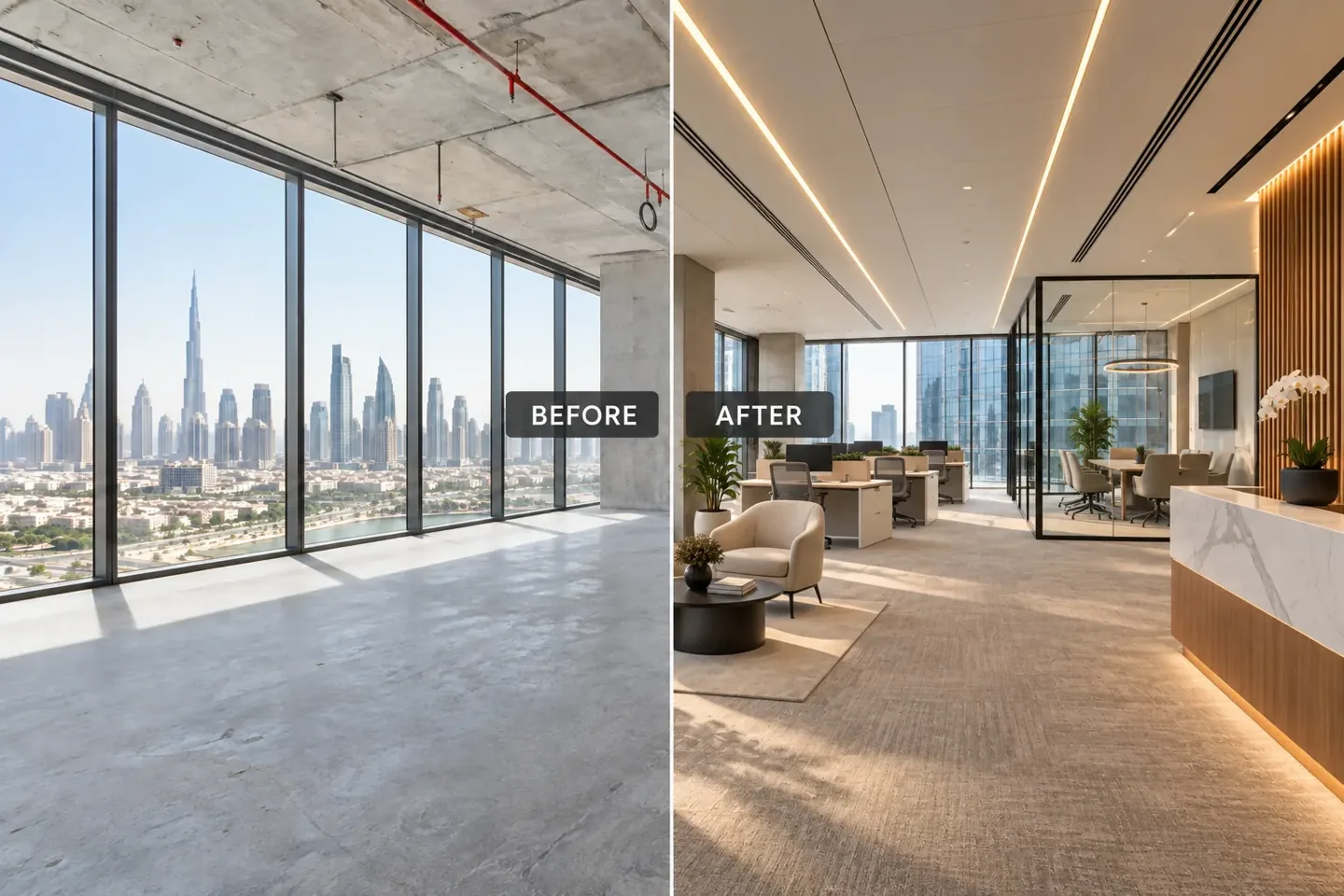
Workplace interior reference for the design review.
An overseas client can take part in a Dubai fit-out without attending every meeting in person. Drawings, video calls and well-prepared photographs can make the important decisions visible. The difficulty is knowing what the material actually demonstrates. A smooth camera movement through a room may explain its arrangement while revealing little about a finish junction, a service test or work already concealed behind a ceiling.
A useful remote review therefore starts with an agreed purpose. Is the client choosing a layout, commenting on a sample, reviewing installation progress or accepting a particular item? Each question needs different evidence and sometimes an on-site professional. This guide explains how to organise those discussions so that the interior design company, client and responsible specialists can work from a shared record. It does not turn remote viewing into a technical certification or suggest that every inspection can be replaced by a call.
Jump to a section 14 topics
Separate decisions from progress viewing
Give each remote meeting one or more defined outcomes. A general progress tour is useful for orientation, but it is a poor setting for an unannounced decision about a detailed drawing. Identify which items need a response and which are being shown for information. Send that distinction with the meeting invitation.
The client should know whether a comment is being requested on appearance, functionality, commercial scope or a technical question for a specialist. These are not interchangeable approvals. If the team asks whether a counter looks right, the answer should not subsequently be interpreted as acceptance of every connection and concealed detail within the counter.
Send a review pack before the camera turns on
Prepare a short pack containing the relevant drawings, item references and questions. Use the current agreed revisions and identify the room or area involved. An overseas client should be able to study a plan at a readable scale before trying to follow it on a shared screen.
Keep supporting material focused. A complete drawing archive may be necessary for the project record, but the meeting pack should make the requested decision easy to find. Include the consequence of choosing an option and any further review it needs. This gives the client time to involve a business partner or operator whose practical input may otherwise arrive after the decision has been treated as final.
Agree who can make which decisions
An absent owner may rely on a local representative, operator or project adviser. Establish which decisions each person is authorised to make and how their instructions are recorded. A representative who attends a site walk may be collecting information rather than approving changes to the construction scope.
The fit-out company should know when an instruction is complete and when it needs further confirmation. Avoid allowing an informal message from an attendee to override a documented decision from the authorised client contact. The arrangement can be simple, but it should be explicit enough that the team does not have to guess whose response releases a purchase or changes an installation.
Give the video tour a reliable orientation
Start by identifying the location and route through the premises. Show the room reference on the plan, then walk through the corresponding area in a deliberate sequence. Wide views help explain relationships between spaces before the camera moves to a particular item.
Do not rely on a fast continuous tour to cover every concern. Pause, name the item and allow the client to ask for a different angle. If network quality is poor, capture a separate high-resolution photograph afterwards. The aim is a shared understanding of the area, not a polished promotional video that hides temporary conditions or moves past unresolved work too quickly.
Use close views for questions about workmanship
A distant view may show that cabinetry is installed without revealing an uneven junction or an unfinished edge. For a specific item, show a wider orientation image followed by clear detail views. Identify the location and avoid images whose lighting or angle makes the relevant feature impossible to assess.
A photograph can document an observation, but it may not establish the cause, tolerance or technical significance of what is visible. Ask the responsible site professional to examine the item where appropriate. Remote clients should distinguish their appearance comment from the competent inspection needed for construction quality, compliance or performance.
Do not approve colour from a screen alone
Camera settings, compression, room lighting and the viewer's display can alter the apparent colour and texture of materials. A video review can explain where a sample belongs and how it relates to adjacent finishes. It should not be treated as a dependable substitute for the physical reference when colour matching is critical.
Discuss practical alternatives. The client might review a physical sample overseas, appoint a local representative or accept a defined selection process with the design team. Record which reference governs the order. Interior design and fit out companies in Dubai should explain these limitations before a remote client is asked to approve a subtle material match from an uncontrolled screen image.
Keep observations linked to identifiable items
Record the room, item and drawing or schedule reference for each comment. A request such as change the shelf is ambiguous when several rooms contain similar joinery. A marked image or clearly identified detail can explain exactly what the client is asking the team to review.
Use the same identifier in the response. State whether the comment has been accepted, requires a revised proposal or needs specialist investigation. This prevents a long message thread from becoming the only record of what is outstanding. It also helps the next meeting focus on the same item instead of reopening a discussion because the previous observation cannot be located.
Handle commercial changes outside casual conversation
A remote discussion may reveal that the client wants a different material, additional storage or a revised layout. Record the request and ask the relevant team to explain its implications before work proceeds. A spoken preference on a video call should not automatically become an accepted variation with unknown cost and programme consequences.
The agreed change process should identify the authorised instruction and the information needed to assess it. Fit out companies in Dubai will need a clear scope to procure and install consistently. Keeping commercial approval separate from an exploratory conversation allows the client to consider the proposal without the site team treating every suggested possibility as a final direction.
Ask what a progress image cannot show
A completed ceiling may conceal installation that was inspected earlier. A running screen may not demonstrate the full performance of its system. Ask which records or competent checks support the statement being made and whether further work remains before an item is ready for use.
The point is not to demand that every remote meeting repeat a technical inspection. It is to recognise the limits of the medium and refer the question to the right evidence. Relevant test reports, inspection records and specialist demonstrations should remain identifiable within the project documentation. A client's visual satisfaction does not replace those responsibilities.
Protect privacy when sharing the site
Agree what can be filmed and who may receive the recording or photographs. The premises may contain staff, personal information, brand material or client-owned equipment. A project review does not automatically authorise public use of its images, and the existence of a video should not be treated as marketing permission.
Use a practical sharing arrangement with the project team. Keep the review material in the agreed project channel and avoid forwarding large, unlabelled image sets to unrelated contacts. If a call is recorded, obtain the appropriate agreement and explain its intended use. The client should be able to review the work without creating an uncontrolled record of private premises or people.
Plan for time differences and missing participants
Choose a review time when the necessary people and information are available. A site tour without the relevant specialist may be useful for general progress but unable to answer the technical question that prompted it. Confirm attendance and the items requiring input before the meeting begins.
If a participant cannot join, agree whether the item can be discussed provisionally or should remain open. Do not turn silence into approval because the client was in another time zone. The programme should distinguish a genuinely outstanding decision from a meeting that did not provide the information needed to make it. A short, properly prepared review can be more useful than a longer call with unresolved attendance.
Finish with a written account of the outcome
Circulate a concise record identifying the items discussed, decisions made, unresolved questions and responsible people. Link to the relevant revisions or marked images. Where the client has requested further information, record what will be provided rather than describing the item as approved with a general comment.
Ask the authorised participants to correct misunderstandings promptly through the agreed process. The record should be readable without replaying an entire call. It becomes particularly valuable when the installation team, supplier or another client representative needs to understand the result later. Remote meetings work better when their practical outcome survives beyond the people who happened to attend.
Use one item to test the review method
Before relying on remote reviews for a large part of the project, trial the method on a clearly defined item. Send its current drawing, show its location and ask the client to explain what decision they understand is required. This can reveal whether the image quality, identifiers and meeting pack are sufficient before a more consequential approval is requested.
Afterwards, compare the written outcome with the participants' understanding. If one person thought a finish had been selected while another understood that only its position had been agreed, correct the process immediately. The trial is useful because communication failures are often about the meaning of approval rather than the quality of the video connection. A small early review can establish a consistent format that later suppliers, site teams and client representatives can follow without inventing their own interpretation of each meeting.
Reserve in-person verification for the right moments
Some matters deserve a competent on-site assessment even when the client cannot attend. Agree which inspections, demonstrations and handover activities need a local professional or representative and define the extent of that person's appointment. A site visit should have a purpose and a record, not simply provide reassurance that somebody was present.
Before final handover, identify the outstanding items, documents and operational demonstrations that remain. The client may join remotely while the responsible parties carry out the physical checks. For an appointment with CBD Projects, describe your availability through the project brief and explore our interior design and fit-out services. The communication plan can then be considered alongside the construction scope rather than added after the owner has already left Dubai.
Frequently asked questions
Can a video call replace a site inspection?
It can support a discussion and show selected visible conditions, but it does not automatically replace the competent physical checks required for the work. Agree what the call is intended to demonstrate and which inspection records or specialist attendance are still needed. The client should not be asked to certify technical performance from a general tour.
How should overseas clients approve samples?
Identify the governing physical sample and agree who will review it. A client may receive a sample or authorise an appropriate local representative. Photographs and video can support the discussion, but screen colour and texture should not be relied upon where a precise physical match matters.
Should every call be recorded?
Not necessarily. A clear written outcome with referenced drawings and images may be more useful. If recording is proposed, agree the participants' permission, access and purpose, especially where private premises or personal information are visible. Keep any record within the agreed project communication arrangements.
What if a remote discussion changes the scope?
Record the request and obtain the necessary assessment of design, cost, procurement and programme implications. Follow the agreed instruction and variation process before treating it as authorised work. An exploratory comment should remain distinguishable from the client's final accepted direction.
References and scope
References checked on 19 November 2026. Confirm current requirements and product instructions for the actual project; these links do not constitute project approval.
Plan your client project planning project with one accountable team
Tell CBD Projects where you will be based and who can represent you locally so a practical project review arrangement can be discussed.
Send Your Project BriefBack to BlogRelated ServiceView Real ProjectsContact CBD Projects