
When a fulfilment operator wins a new merchant account, the stock is only part of what arrives. There may be a different carton family, branded inserts, a new label format and a client who wants to see how its goods are kept apart from another seller’s orders. A second account can require a separate packing position even when the warehouse still has plenty of storage capacity. CBD Projects LLC can help define and build the interior changes needed to introduce that account into an operating UAE e-commerce warehouse.
Start with two anonymous example orders, one for the new merchant and one for an existing account. Include the packaging each uses and the points at which a member of staff takes responsibility for it. We can develop a measured proposal for the receiving, storage-support and packing areas affected. The operator retains control of its inventory system, customer agreements and fulfilment decisions. Names, sales figures and customer addresses can be removed from the briefing documents.
Define what the merchant actually needs kept separate
Distinguish between stock, packaging materials, records and the people allowed to handle them. A merchant might accept a shared working table but require its printed packaging to be held in a dedicated cupboard. Another might supply its own label stock and expect the remainder to be counted and returned at the end of a promotion. These arrangements have different building implications. A request for a secure area alone does not tell an estimator whether to allow for a cabinet, a room or a supervised collection point.
Ask the contract owner to describe the evidence the merchant expects at handover. It might be a walk through an agreed boundary, a count of issued cupboard keys or a trial packing exercise. Record which requirement is an operator procedure and which requires installed work. The accepted list gives the buyer a way to avoid paying for partitions that do little for the actual custody requirement. It also identifies requirements that a new counter or lock cannot satisfy without a matching operational process.
Check the stock arrival that the normal process cannot accept
Take a delivery example in which the outer carton carries the correct merchant name but the contents cannot yet be assigned to an order. Ask who can investigate and where the carton can stand until the decision is recorded. At the same time, ordinary receipt for existing accounts must still have a usable position. Look at access to the discrepancy area with a trolley and a partly opened carton present. A plan drawn only with closed boxes can underestimate the space taken up during checking.
Decide with the operator whether the exception area needs physical enclosure, a controlled cupboard or a supervised bench. Mark its relationship to any scanning or printing point, including where the employee can put paperwork while handling the carton. Give the manager a room-level schedule showing each agreed fitted component and its purpose. The operator defines the stock status and authorises release. The built arrangement provides a place where employees can carry out those decisions without returning an uncertain item to ordinary stock by mistake.
Trial one order from each account at the proposed bench
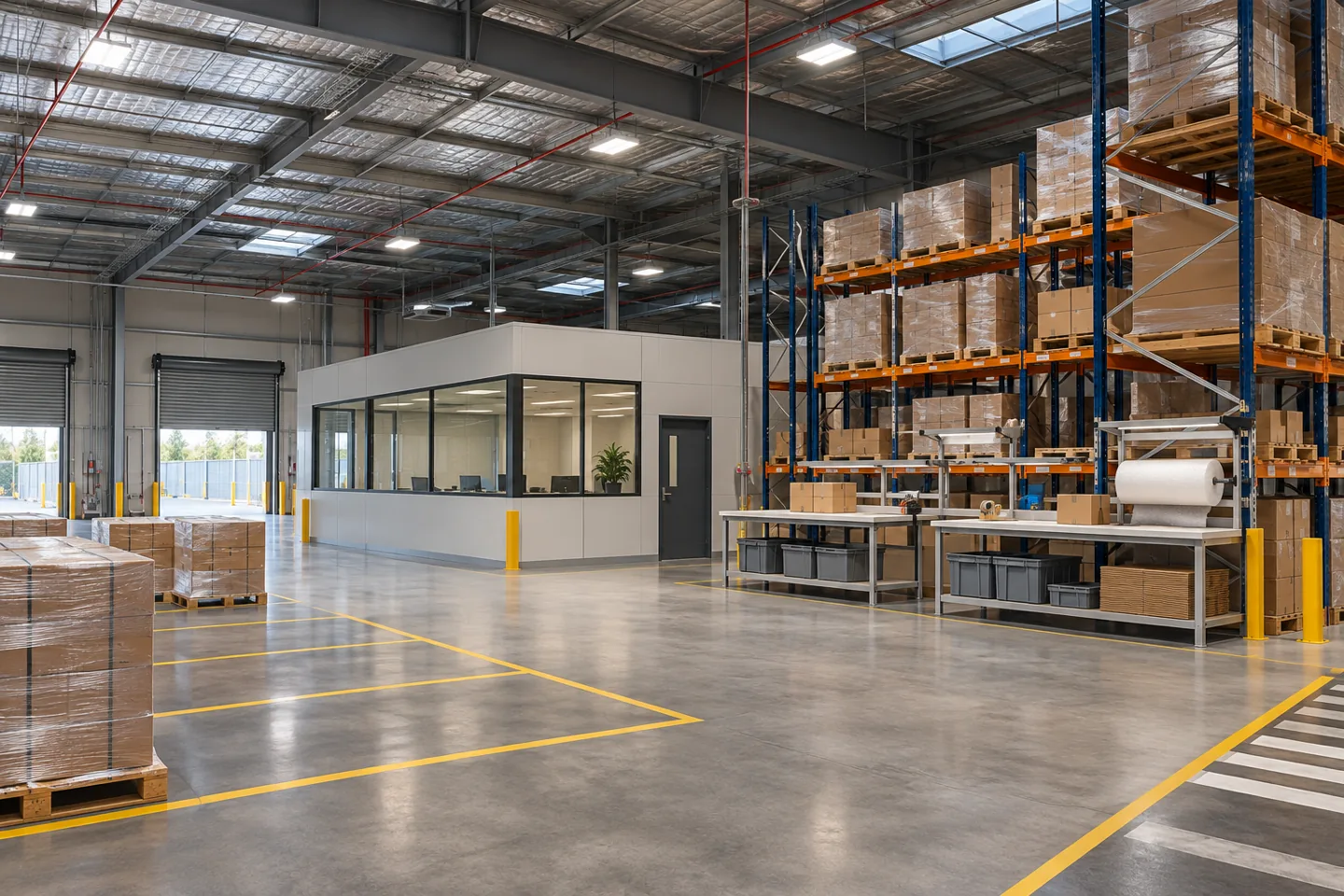
Place a sample product, the new merchant’s largest regular carton, its insert and the actual dispensing equipment on the work surface. Pack the order in sequence, starting with the carton flat and ending with it sealed and labelled. Then reset the position for the existing account. Notice what remains on the bench between jobs. An unused sleeve or label left within reach can be the item that causes the wrong brand to leave the building.
Use what the trial reveals to specify the joinery and fittings. A shallow compartment beside the packer may suffice for inserts used on every order. A carton family needed once per shift could occupy shared replenishment storage. A drawer with the right internal dimension may still prevent a colleague from passing when fully open. Draw the working position with the drawer extended and an assembled order on the table. Obtain agreement from the operator before commissioning the fabrication detail.
Give merchant-owned consumables a defined path
Ask who receives branded consumables, who counts them into the packing area and where remnants go after a campaign. Some printed material has little purchase value but causes considerable rework if an obsolete version is packed. Design a place for incoming material awaiting release and a different location for material the operator has withdrawn. Show who can access each location. The client can choose between movable storage and permanent construction once the volume and handling pattern are known.
The replenishment route matters as much as the cupboard. A carton bundle carried across a busy dispatch position can interrupt existing accounts each time supplies run low. Review how the packer signals for more material and where a replenishment trolley waits without blocking an unfinished order. A supplier’s list of shelf dimensions will not reveal that conflict. A trial with ordinary empty packaging often gives the operator enough evidence to choose the more useful cupboard position before installation.
Plan for a promotion without building for one peak forever
A seasonal promotion can introduce gift wraps, personalised cards or extra inspection. Ask the merchant for the longest task and the bulkiest item, together with the expected period during which they apply. If an extra table is needed for a limited campaign, define where it connects and parks afterwards. Avoid treating a temporary queue of nearly finished orders as a permanent need for another enclosed room. Draw both normal and peak arrangements so the operator can compare them.
Test the point at which a partially packed order leaves the ordinary bench. Who can pick it up again and what needs to stay with it? A numbered movable cart may achieve the required separation provided the operator controls the order reference and custody. Where fixed shelves are chosen instead, agree the largest usable opening and the way staff retrieve an order from the back. The quotation should say which part is fixed, what remains portable and who supplies the loose equipment.
Release one work area while other merchants continue shipping
Develop a construction sequence using the operator’s actual order cut-offs, supplier bookings and stock access needs. Identify which areas can be closed, how the affected existing packer will work during that closure and who checks that a temporary station has all the equipment it needs. A temporary move can fail because the label rolls or carton blanks moved to a different place from the printer. Assign the restoration of the existing account’s normal position to a named party.
Show construction delivery routes and waste collection on the phase drawing, particularly where they approach areas holding merchant stock. Ask the operator what access records it requires and agree what a contractor may photograph. List the items that must be installed before IT attendance, such as fixed counters, cable routes and any permitted power provision. The nominated providers confirm their technical requirements and test their systems. CBD coordinates the agreed building works and records when an area is available for that attendance.
Check the premises before making a national rollout allowance
An account may start at one warehouse and later move into a second UAE facility. Retain the approved packing detail and component list as a reference, then verify the second location. Doors, loading access, landlord boundaries, working hours and the route for services can all be different. A fixed bench may repeat exactly while the surrounding construction needs a new design. Identify the parts that are repeat orders and the parts that must wait for local measurements.
For an Abu Dhabi facility, ADDED identifies business activity and location as factors in additional approvals. Establish the applicable property and authority arrangements for the actual work. CBD can prepare the agreed details, shop drawings and applications in house, coordinating specialist information where required. Appointed engineers and suppliers retain the relevant technical duties for services and storage systems. The building owner and relevant authorities decide their respective applications. A successful trial for a merchant at another address answers a different question from permission to carry out the work here.
Price the installed work against a measurable example
Request a quotation based on a named configuration and an agreed number of working positions. Identify surveyed alterations, new joinery, protection, access bookings and any works to existing stations. Ask which components the client will buy directly and who installs each one. A price for a bench can omit its storage, protection or return attendance after the printer arrives. The operator can compare proposals fairly when the same sample order can be completed at each quoted position.
If the account volume is provisional, separate the first working station from repeat stations and shared enabling work. Show which dimensions must be confirmed before fabrication and which items can be ordered after a first trial. Price any later attendance explicitly. A client can then decide whether committing to a second station now is worthwhile or whether an agreed future connection point is sufficient. The operator can use its own demand figures without sharing confidential revenue assumptions with the fit-out team.
Bring your brief into focus
Send two dummy orders and a redacted plan to discuss adding a merchant account.
Send your project briefHand over a format the next shift can understand
At completion, ask the outgoing and incoming shift supervisors to walk through the same two sample orders used at briefing. Check whether unused branded materials can be returned to the agreed place and whether an unresolved item has a clear destination. Record observations against an identifiable shelf, door, cabinet or working position. Distinguish a construction snag from a revised operating preference so the buyer can deal with any extra cost openly.
Provide the agreed installation drawings, finish care information, component details and key handover. Make records available to the operator in a form that can be redacted before sharing with an individual merchant. Do not include another seller’s stock photographs in a demonstration pack. Supplier commissioning, warehouse-system configuration and merchant acceptance remain separate records held by the parties responsible. Their status should be clear when the operator decides to release a position for live orders.
Allow one merchant to leave without closing another account
At the start of an account, agree what the operator expects to remove when the agreement ends. A branded back panel may belong to the merchant while the packing bench belongs to the warehouse. Fix them so the panel can be replaced without exposing another account’s stock or dismantling the adjoining station. Identify where withdrawn labels and packaging can wait for collection after the last order leaves.
Price this future change as a defined operation if it affects the initial choice of fittings. A replaceable insert can cost more to manufacture than a printed finish fixed directly to a cabinet. The owner can decide whether that difference is worth paying after seeing what removal, making good and a second installation visit would involve.
Frequently asked questions
Can we start with a new brand whose packaging is still being developed?
Yes. Bring the current carton samples and the outstanding decisions. We can test the largest likely arrangement and identify which items can stay adjustable until the packaging is agreed. Delay only the affected fabrication details and keep the assumptions visible in the proposal.
Must each merchant have a separate room?
That depends on the operator’s agreements, goods and working method. Identify the particular custody or handling requirement and try the proposed arrangement with both accounts represented. We can price the accepted physical solution and describe what the operator must manage through its own procedures.
What should we provide for the first discussion?
A redacted premises plan, two dummy orders, sample packaging and the intended launch sequence are useful. Tell us who supplies the equipment and what must keep operating during the works. We can identify a sensible survey scope before you disclose any commercial details specific to the merchant.