
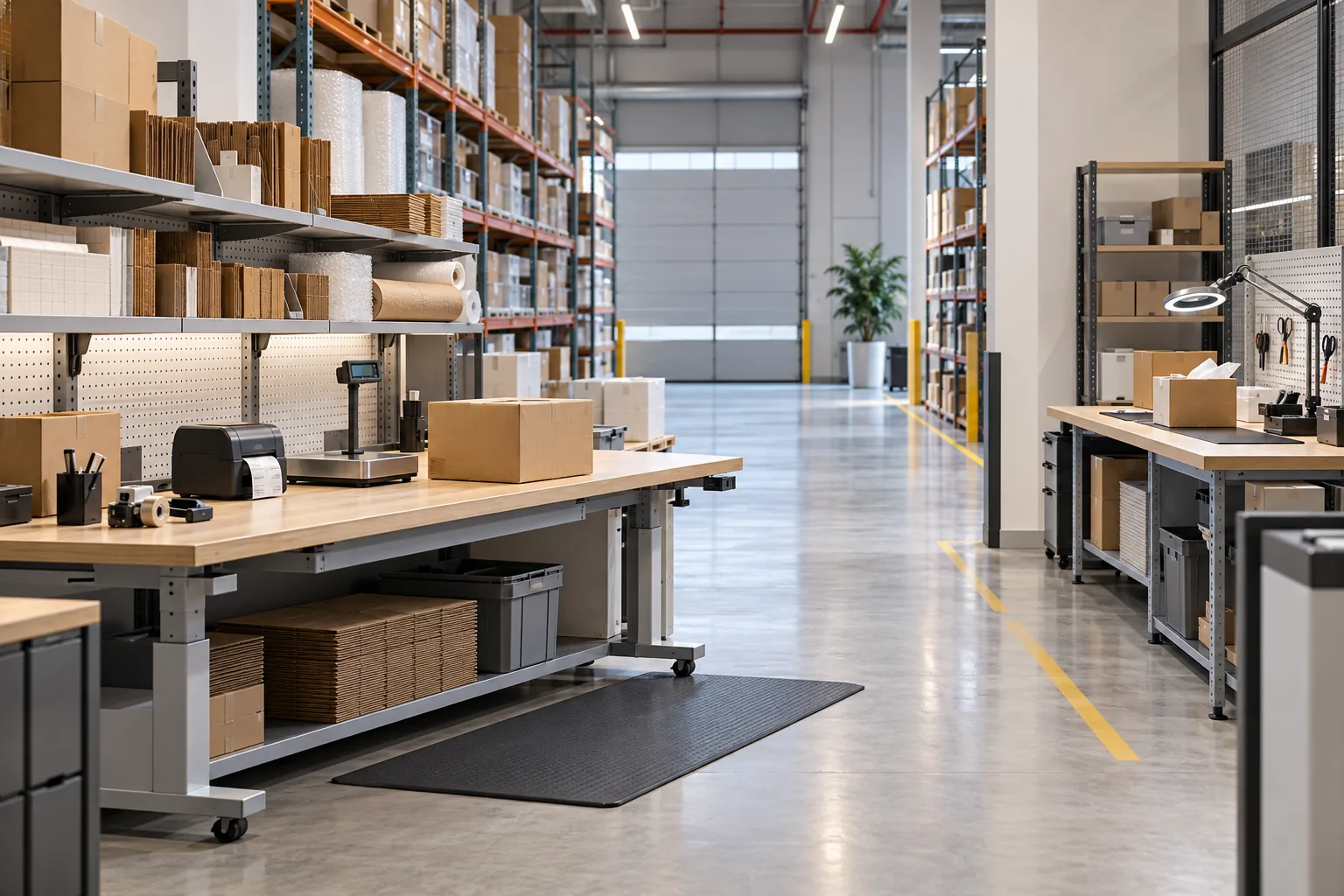
Illustrative design concept.
Map the packing sequence, size the station around representative orders, and coordinate replenishment, services and finished-order movement. Trial one station with the operations team before repeating it across the warehouse.
A line of new benches does not automatically create an efficient packing area. Operators need space for the item, packaging, weighing, labelling and completed orders without repeatedly leaving the station. Start with the order profile and material flow before deciding how many benches fit.
Jump to a section 15 topics
Use the actual order mix
Collect typical and unusually large parcel dimensions, packaging types and the tasks required for each order. Record peak working periods and the number of staff at each station. Do not base the design on average parcels alone if large or fragile orders are a significant part of the operation.
Arrange tasks in a usable sequence
Show incoming picked goods, packing materials, weighing, labelling and outgoing parcels. Keep frequently used tools within a convenient working zone while allowing sufficient clear surface for the largest normal task. Review working posture and manual-handling needs with the appropriate workplace specialist.
Consider whether adjustable benches are useful for different tasks and users. A fixed height should not be selected solely to match adjacent furniture. Test the proposed setup with representative cartons before committing to a full production run.
Plan replenishment separately
Decide how boxes, tape and protective materials arrive without interrupting active packing. Provide defined storage for daily quantities and a route for replenishment. Avoid filling aisles with packaging because the bench design omitted reserve capacity.
Coordinate the stations with the warehouse pedestrian-route plan. Keep the workstation footprint distinct from circulation, equipment travel and emergency routes as reviewed by the responsible designers.
Coordinate power, data and lighting
Obtain requirements for scanners, printers, scales, computers and any specialist packaging equipment. Plan connections and cable management so equipment can be serviced without trailing leads across working routes. Confirm the actual loads with the relevant installer.
Review lighting for labels, checking and packing tasks while avoiding shadows from storage above the bench. Identify how devices will be secured and replaced. An attractive workstation rendering is not enough to establish that the technology can operate reliably in its proposed location.
Measure the pilot before repeating it
Ask operators to complete a representative set of tasks at the first station. Record unnecessary reaching, walking, congestion and storage overflow. Include replenishment and removal of completed orders, not only the packing action itself.
Agree modifications before duplicating the layout. Keep the accepted workstation dimensions, equipment positions and finish specifications as a controlled reference. For a wider warehouse conversion, combine this review with the warehouse fit-out guide.

Choose a station type for the actual order profile
A bench that suits small repeat orders may be awkward for mixed or fragile goods. Separate the common tasks from occasional exceptions, then decide whether one adaptable station or several specialised positions will work better. Operations should supply representative orders, including awkward packaging and items requiring extra checking.
| Station approach | When to investigate it | Constraint to test |
|---|---|---|
| Repeated standard bench | Similar parcels and repeated tasks | Variation in users and occasional large orders |
| Adjustable workstation | Different tasks or users share a position | Adjustment method and equipment compatibility |
| Oversize packing area | Bulky items need clear working space | Handling route and completed-order staging |
| Shared specialist equipment | A device is used intermittently | Queues and movement between stations |
Do not turn the table into a purchasing rule. Trial the arrangement with the people performing the work and the relevant workplace specialists. The selected equipment, goods and handling procedures determine the safe, usable setup.
Treat label and order accuracy as a spatial problem too
The operations team should define identification and checking procedures, but the bench needs to support them. Provide distinct places for the active order, supporting paperwork where used, labels and completed parcels. If several orders occupy the same unmarked surface, staff may have difficulty maintaining the intended separation.
Check scanner positions and screen visibility under the proposed lighting. Ask whether equipment can be reached without moving the parcel repeatedly. A label printer may need replenishment or access to clear a fault; burying it under shelves can make a routine task disruptive.
Review how the system behaves when an order is interrupted. Where does an incomplete parcel wait, how is it identified and how does another operator understand its status? The fit-out cannot establish inventory policy, but it can provide the surfaces, locations and visibility needed to follow that policy consistently.
Give packaging and waste different routes
Replenishment should bring materials to the station in usable quantities without filling the active work surface. Ask how cartons, void fill, tape and other supplies are stored and delivered. Large reserve quantities may belong nearby rather than on every bench, provided replenishment does not interrupt the packing sequence.
Waste has its own pattern. Empty supply packaging and offcuts should leave the station without contaminating the active order or obstructing staff. Agree container positions and collection responsibilities with operations. A bin shown in an empty corner on the drawing may be inaccessible once carts are in use.
Test peak conditions, including the time when finished parcels await collection. If outgoing staging fills first, adding benches can worsen congestion rather than increase useful capacity. Compare the entire packing-to-dispatch sequence before increasing the workstation count.
Specify the bench for maintenance and future changes
Document the actual work surface, edge detail, supporting construction and intended equipment. Suppliers should confirm suitability for the loads and activities; a furniture description such as heavy-duty is not enough. Include cable management and replacement access for the chosen devices.
Ask which components can be repaired or replaced independently. A sacrificial work surface or accessible mounting rail may be useful where equipment changes frequently, but assess it against the operator's cleaning and product-handling needs. Avoid permanent details that make a simple printer replacement require dismantling the bench.
Record the accepted pilot arrangement with photographs, dimensions and equipment references. During rollout, check that sockets, shelves and aisle interfaces remain consistent at each location. Where a column or doorway changes the setup, review that station as a variant rather than forcing the standard arrangement into an unsuitable space.
Trial a new product before repeating the bench
When a new range is introduced, ask operations to provide a representative complete order in its intended packaging. Include accessories, inserts and any documents used under the business's process. The bench should be reviewed against the physical task rather than an updated product description alone.
For a hypothetical promotional bundle, several small products may become one larger finished parcel. Ask where the components arrive, how the operator identifies the active order and where the completed package waits. The appropriate workplace and handling specialists should review the proposed arrangement and method.
Compare adapting the standard station with using an identified special-order position. The first preserves a familiar setup but may alter storage or device locations. The second needs a staffed process and support of its own. Record the option selected by operations before purchasing a different work surface.

Give rework a destination separate from new orders
Ask what happens when an already packed item needs correction under the operator's procedures. Identify who decides the next action, where the parcel waits and which materials are required. Reopening a parcel can create a different task from assembling a new one.
Use a hypothetical wrong accessory to rehearse the physical sequence with fictional order details. Ask where removed packaging goes and how replacement components reach the operator. Keep identification and release rules with the business; the designer should provide the surfaces and locations needed to support them.
Compare a defined rework position with scheduled use of a normal bench. The choice should reflect observed demand and staffing rather than assume a separate room is always necessary. Include the return of a corrected parcel to the approved dispatch process so rework does not become an unexplained end point.
Make an interrupted order transferable
Ask operations how another employee takes over an incomplete order. The agreed process may need a physical location, a status reference or a place for associated components. The fit-out should not rely on one person remembering which loose items belong together.
For a hypothetical shift change, leave a representative unfinished parcel under the operator's controlled method and ask the incoming employee to identify its next step. Observe whether the workstation provides the expected information and storage. Use fictional records and the appropriate operating supervision.
Record whether the finding concerns procedure, information or physical arrangement. Another shelf will not fix an unclear release rule, while a clear rule may still need a suitable holding position. Give the response to the party able to make the relevant decision before duplicating the station.
Specify consumables through the replenishment task
Ask purchasing and operations how cartons, tape, label media and other selected materials arrive and are distributed. Include pack sizes and the containers used at the station. The bench inventory should distinguish working quantities from bulk reserve stock.
For a hypothetical change in label supply, ask whether the new delivered package and working item suit the selected printer and storage arrangement. The supplier and technology owner should confirm compatibility. A purchasing change should not be treated as physically irrelevant simply because the material has the same general name.
Give incoming stock, opened working supplies and items awaiting supplier review distinct destinations through the operator's process. Ask who replenishes them and who removes packaging. This prevents the bench's useful surface becoming a temporary store every time a bulk delivery is opened.
Check repeated stations as installed variants
After the pilot is accepted, compare each installed station with the approved reference. Identify differences caused by columns, doors, adjacent equipment or service positions. Have the responsible designers and operator review a variant rather than describe every repeated bench as identical.
Use actual device references and mounting accessories in that comparison. A substitute bracket or screen position may alter the working surface even when the bench itself matches. Ask the relevant suppliers to identify affected interfaces and obtain the appropriate review before rollout continues.
Keep current photographs and drawings with station references. The operating team should be able to report an issue at a specific position and locate the corresponding supplier information. This supports later repairs without relying on the installer remembering which bench was adjusted on site.
Keep an agreed set of representative packaging with the pilot record where practical. A future supervisor can then recognise the task used for acceptance and identify when a changed order profile needs another review.
Accept the support arrangements behind the packing task
Include a fictional device fault and a consumable shortage in the final usability review. Ask who provides assistance, where replacements are held and what the operator does with the current order under its procedures. Technical diagnosis and operating decisions remain with the appropriate responsible parties.
Keep supplier demonstrations, construction checks and operator familiarisation separately identifiable. A person completing one sample parcel does not establish every technical or operational acceptance requirement. Agree which evidence each appointment supplies and keep outstanding actions visible.
At closeout, have a relief supervisor locate a station reference, a consumable position and the appropriate support contact from the operating index. Correct unclear labels or missing links while the project team remains available. When product or staffing patterns change, use the record to commission the affected review rather than add isolated equipment to the nearest spare surface.
Frequently asked questions
How many packing benches should a warehouse have?
Determine this from order volume, task time, staffing and peak demand. Floor area alone is not a reliable basis.
Can packing benches be placed in spare aisle space?
Do not assume an aisle is spare capacity. Review circulation, equipment movement and safety requirements before changing its use.
Where should a second label printer go?
Watch what happens when the first printer runs out during a packing peak. If an operator must leave an open parcel unattended, test a shared backup within reach of both benches and check how staff identify the correct parcel after interruption.
Plan your commercial fit-out planning project with one accountable team
Share your warehouse packing station fit out brief, plans and priorities with CBD Projects for a practical scope discussion.
Send Your Project BriefBack to BlogRelated ServiceView Real ProjectsContact CBD Projects