
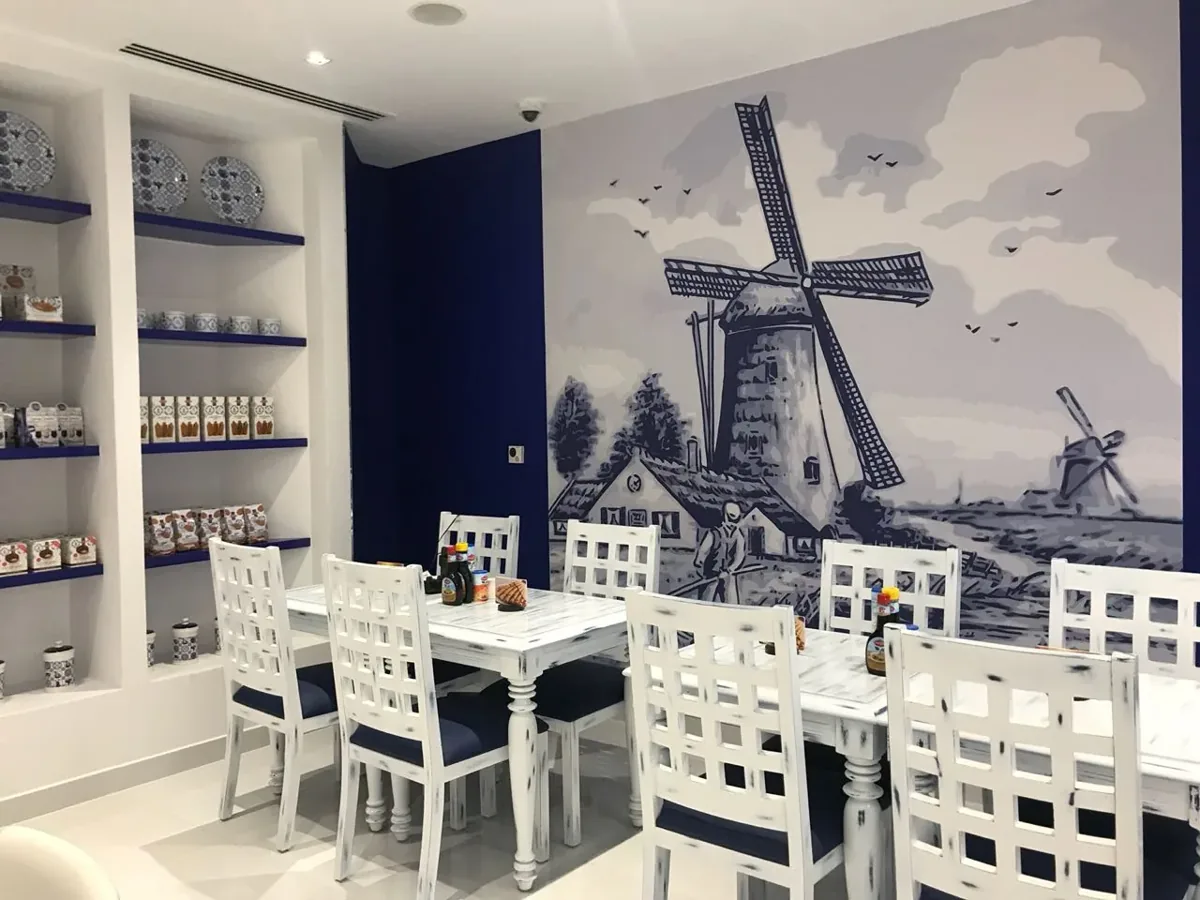
Interior reference for coffee shop order and beverage handoff layout.
A customer pays for two drinks, steps aside and waits. Another approaches the same surface to order, while a third asks whether the cup on the counter belongs to them. Each task is ordinary. The difficulty comes when the layout gives all three people the same position and the barista must repeatedly stop to explain what happens next.
A coffee shop handoff brief should follow the transaction from the customer's decision to the completed collection. The aim is to make the next action understandable while preserving a workable staff sequence. Start with the service the cafe intends to offer, then test a furnished counter with realistic orders and interruptions.
Jump to a section 10 topics
Write the transaction before drawing the counter
List the actions in an ordinary purchase: inspect the offer, ask a question, order, pay, receive any receipt or reference, wait and collect. Identify which employee handles each action and which device or surface they use. Several actions can share a position when the operating model supports that choice. The important point is to make the sharing explicit instead of letting the longest available countertop become the answer to every task.
Describe the menu at the level needed for handoff. A single ready-to-collect item creates a different sequence from an order containing drinks completed at different stations. The operator's qualified food team should establish handling procedures. The designer needs the resulting assembly, checking and collection tasks, without turning the layout exercise into a new food-handling protocol.
Keep the visible customer sequence separate from the barista's production work. A coffee shop interior design consultant should coordinate the two, but a plan that moves customers neatly can still place their questions directly beside the employee completing drinks. For machine positions and service interfaces, use the separate cafe equipment coordination guide. This handoff review begins where the customer decides what to do next.
Use a mixed-order scenario to expose the first conflict
Consider a hypothetical morning with three parties arriving close together. One orders a single drink. Another orders two different drinks and a pastry. The third wants an explanation before ordering. These are illustrative transactions, not a forecast or service-time benchmark. Give each party a position on the plan and ask the operator to describe where the employee's attention goes.
Now let the first drink finish while the second party's order remains incomplete. Identify where the completed item is presented and how its customer approaches it. Does that movement cross the third party's conversation? Does the employee checking the larger order need the same landing surface? Record the actual conflict before deciding whether the solution is another shelf, a revised counter orientation or a different operating sequence.
Repeat the scenario after changing just one fact: the first customer steps away briefly. The operator should decide how an uncollected order is handled and identified. The layout should support that process without making a ready item indistinguishable from an item still being checked. A counter can look adequate with one cup and fail as soon as several transactions occupy different states.
Separate the purpose of the order point and collection point
The order point supports a conversation and transaction. Collection supports recognising the completed order, approaching it and leaving. Compare separate positions with a shared surface using the expected staff and customer pattern. Separation may make the sequence clearer, but it can also add distance or require another communication step. Choose it because the complete operation works, not because a reference photograph shows two signs.
Use the actual payment device, menu information, cup formats and other ordinary items in a counter mock-up. Mark what customers may approach and what remains a staff working position under the operator's procedures. The responsible designer should assess circulation, accessibility and other applicable requirements. This guide gives no universal counter width, queue allowance or mounting height.
Test the final furniture around the counter as well. A collection position beside a table may be usable when the chair is tucked in and awkward when someone sits down. A promotional stand may obscure the only clue that collection happens farther along. Draw occupied seats, bags where relevant and the staff replenishment movement before treating the counter's clear elevation as a complete layout.
Make order status understandable without constant explanation
Ask how the cafe identifies a customer's order and communicates that it is ready. The answer may involve an operator-approved reference, a staff announcement or a selected display system. Establish the method before designing signs and screens. Keep personal information within the operator's appropriate process, and use fictional details when testing the arrangement.
Place the intended information where a waiting customer would naturally look. Test it from the actual waiting positions, including a person who has never visited. Ask what they believe they should do next. If they repeatedly approach the payment point to check progress, find out whether the information is absent, hidden or difficult to interpret before adding more counter length.
Keep terminology consistent. A sign saying pickup, an employee calling collection and a screen showing another label may each be understandable alone but create hesitation together. Agree a simple language system with the operator and review any additional language needs for its audience. The design should support the cafe's chosen service, rather than leave every shift to explain a different sequence.
Give exceptions a position and an owner
A customer querying an item, changing an order or asking about a missing component needs staff attention. The operator should establish the appropriate commercial and food-handling response. The layout review asks where that conversation happens and what space it occupies. An exception should not automatically force the customer to stand in the only approach to completed drinks.
Run a fictional query during the mixed-order scenario. Identify who acknowledges it, where the customer waits and whether the employee can continue another task. A separate assistance position is useful only if the staffing model supports it. Moving the label without changing the employee's workload can simply relocate the queue.
Record the distinction between a physical problem and an operating decision. A screen may be badly positioned; an order-reference method may be unclear; a staff responsibility may be unassigned. Each needs a different response. Keep observations specific enough that the operator, designer or supplier can act, instead of compiling a general list saying the counter feels busy.
Keep takeaway, seated service and courier collection distinct
A seated customer may expect an item to arrive differently from a takeaway customer. Ask the cafe to define its actual service model, including whether customers return to the counter for part of an order. Mark the route to tables and the position used for clearing or customer questions. Do not count the same counter edge as continuously available to every channel.
If third-party delivery is offered, review it as another collection interface. A courier waiting with equipment may need different information and a different destination from a guest collecting one drink. The restaurant delivery pickup guide develops that route. Adding the courier task should not erase the ordinary customer handoff the coffee shop has already designed.
For a hypothetical cafe with all three channels, place one customer from each in the plan at the same moment. Trace arrival, waiting and departure. The operator may change a collection method or timing instead of construction. Keep the chosen arrangement in the brief so a later delivery launch or table-service change triggers a review rather than quietly consuming the handoff space.
Reserve the working stock needed to finish an order
List cups, lids, sleeves, napkins, bags and other packaging used at the handoff, using the actual products. Distinguish point-of-use stock from reserve cartons. The operator's responsible team should establish appropriate storage and handling. The designer can then provide the accepted locations without assuming the presentation shelf can also hold the entire day's supplies.
Test replenishment during a busy period. Identify who retrieves stock, where an open carton waits and which customer task continues at the same time. If the only workable method blocks collection, compare a different store, smaller working quantities or an operator-managed replenishment interval. The choice should reflect staff availability, not a theoretical trip that nobody can perform.
Include discarded packaging and items awaiting the operator's reviewed process. They need destinations distinct from the surface customers interpret as ready for collection. This is a spatial coordination question, not a prescribed hygiene routine. Make the staff's accepted reset method possible before approving a seamless counter front that conceals useful storage or access.
Check the larger order the cafe intends to accept
A customer collecting several drinks creates a different handoff from several customers each collecting one. Ask the operator which larger orders it intends to accept and how they are identified, checked and presented under its procedures. Use the actual carrier or packaging in the layout review. A surface sufficient for an individual cup may not support that complete transaction alongside ordinary collections.
For a fictional office order, place the representative packages at the agreed handoff position while another customer approaches. Identify where the collecting customer stands, confirms the order and departs. The operator's qualified team should establish handling requirements; the physical review checks the space and staff task. If the arrangement cannot support the offer, compare a separately managed collection or a different counter allocation before advertising a service the ordinary layout cannot deliver.
Record the result of a handoff trial
Use the same fictional orders and props when comparing layouts. Observe the point of hesitation, repeated question or conflicting movement, rather than judging one option during a quiet demonstration and another during a busy one. An operator can also collect simple observations in an existing cafe without identifying individual customers. State the time and service conditions behind the evidence.
| Observation | Question to resolve | Possible next review |
|---|---|---|
| Customers return to payment for status | Can they recognise the collection method? | Information position and wording |
| Completed items occupy staff checking space | Are preparation and handoff states distinguishable? | Surface allocation and operator process |
| A query stops every collection | Who handles the exception and where? | Staff task and assistance position |
| Stock replenishment crosses the queue | Does reserve storage support service? | Storage location or replenishment sequence |
Choose one response and repeat the affected scenario. A sign correction should be tested as a sign correction; a moved collection surface should be tested with its new approach. Avoid changing several things and claiming the layout solved the problem without knowing which action mattered.
Brief the design company with a complete customer handoff
Before appointing a coffee shop interior design company, assemble the menu and service model, the selected transaction devices, representative packaging and a plan of the actual premises. Add the busiest credible overlap and the staff roles expected to support it. Identify what is verified and what still requires the relevant designer, supplier or specialist review.
Ask the proposal to state what it will deliver: customer-flow options, coordinated counter information, equipment interfaces within scope and a method for reviewing the selected arrangement. A finished counter is only one project output. The practical objective is a handoff that customers can understand and staff can operate using the resources the cafe intends to provide. The wider cafe interior design guide connects that decision with seating and the rest of the premises.
Frequently asked questions
Should coffee ordering and collection always be separate?
No universal arrangement suits every cafe. Compare the complete ordering, waiting, collection and staff sequence. Separate points help when they solve a defined conflict and the staffing model can support them.
What should we use in a handoff mock-up?
Use the selected transaction devices, representative cups and packaging, actual furniture footprints and fictional mixed orders. Include a delayed collection, a customer query and stock replenishment rather than demonstrating only one successful purchase.
Does a clearer handoff need more floor area?
Sometimes a physical change is useful, but first identify the cause. Information, surface allocation, staff responsibilities and collection methods can create different conflicts that another queue area alone would not resolve.
Plan your retail and hospitality interiors project with one accountable team
CBD Projects LLC provides interior design and fit-out coordination across Dubai and the UAE. Share your space, location, target opening date and budget range for a practical first review.
Send Your Project BriefBack to BlogRelated ServiceView Real ProjectsContact CBD Projects