
An Abu Dhabi kiosk appointment should cover what happens after the launch as carefully as the installation itself. For a temporary retail activation, the operator needs an agreed assembly, reliable venue interfaces and a practical plan to remove or relocate the unit when the trading arrangement ends. CBD Projects LLC can discuss interior detailing, fabrication coordination and site installation within a defined kiosk fit-out scope.
The first review establishes the product offer, actual location and whether the kiosk is intended to remain, move or be dismantled. Our in-house team handles interior details, shop drawings and agreed application coordination. The operator and responsible professionals retain their commercial licensing, technical and statutory roles. Delivery suitability and applicable local project eligibility must be confirmed before an Abu Dhabi appointment is agreed.
Define the whole appointment, including the exit
State the intended trading arrangement, installation window and what the operator expects to happen at the end. A kiosk leased for a temporary campaign needs decisions about removal, storage, refurbishment or disposal. Do not leave those decisions until the venue asks for its floor back. The commercial scope should name who carries out each stage and which services are separately appointed.
Identify what the operator owns and what is hired or supplied by others. A branded counter, payment terminal and illuminated sign may have different ownership and return arrangements. Record those boundaries before fabrication so the finished assembly can support the intended separation. A low initial construction figure is difficult to assess if the operator has no understanding of the later removal obligation.
Establish the actual Abu Dhabi trading location
Obtain the venue-approved position, dimensions and conditions for the proposed activity. Clarify the responsible jurisdiction with the operator’s advisers instead of assuming that every Abu Dhabi kiosk follows one process. A mall management acceptance, an operator’s commercial permission and a contractor’s access arrangement serve different purposes and need identifiable owners.
For a location within ADGM, its published temporary-permit page refers to landlord or mall no-objection information and applicant licence documents. ADGM also published a December 2025 announcement introducing temporary-commercial permit rules. Confirm the current applicable route with the responsible parties; these references are not a promise of permission or a checklist for every Abu Dhabi venue.
Turn the concession position into a measured site brief
Inspect the actual position and the route through which components will arrive. Record the boundaries the venue has accepted, retained floor finishes, nearby fixed obstructions and the available service interface information. Ask the appropriate technical parties to verify relevant connection conditions. A marked rectangle on a leasing brochure is not sufficient manufacturing information.
Keep the approved trading area separate from delivery and temporary storage arrangements. The operator may be allowed to occupy one position while needing a different authorised area for assembly. Agree that arrangement with management before planning the installation. If the venue changes the position, review dimensions, access and services together rather than moving the same drawing pin to a new location.
Choose a construction strategy that matches the intended life
Decide which parts can arrive as completed assemblies and which must be joined on site. Consider the actual access route, handling resources and future removal sequence. Ask the fabricator to show where components separate and how finishes at those junctions will be protected. The relevant designers and specialists should establish structural, fixing and technical suitability.
A removable appearance is not evidence that an assembly is safe to move. Identify the party responsible for handling and the information they need. If the operator hopes to reuse the kiosk elsewhere, distinguish a practical design objective from a guarantee that every future venue will accept it. Later locations need their own dimensions, permissions and technical review.
Where the operator expects several campaigns, ask the fabricator which visible components are likely to need inspection or renewal between installations. Include the agreed inspection in the commercial scope. Repeated handling can change the condition of an assembly even when the merchandising concept remains the same, and the next installation needs its own readiness decision.
Make the counter support a complete working shift
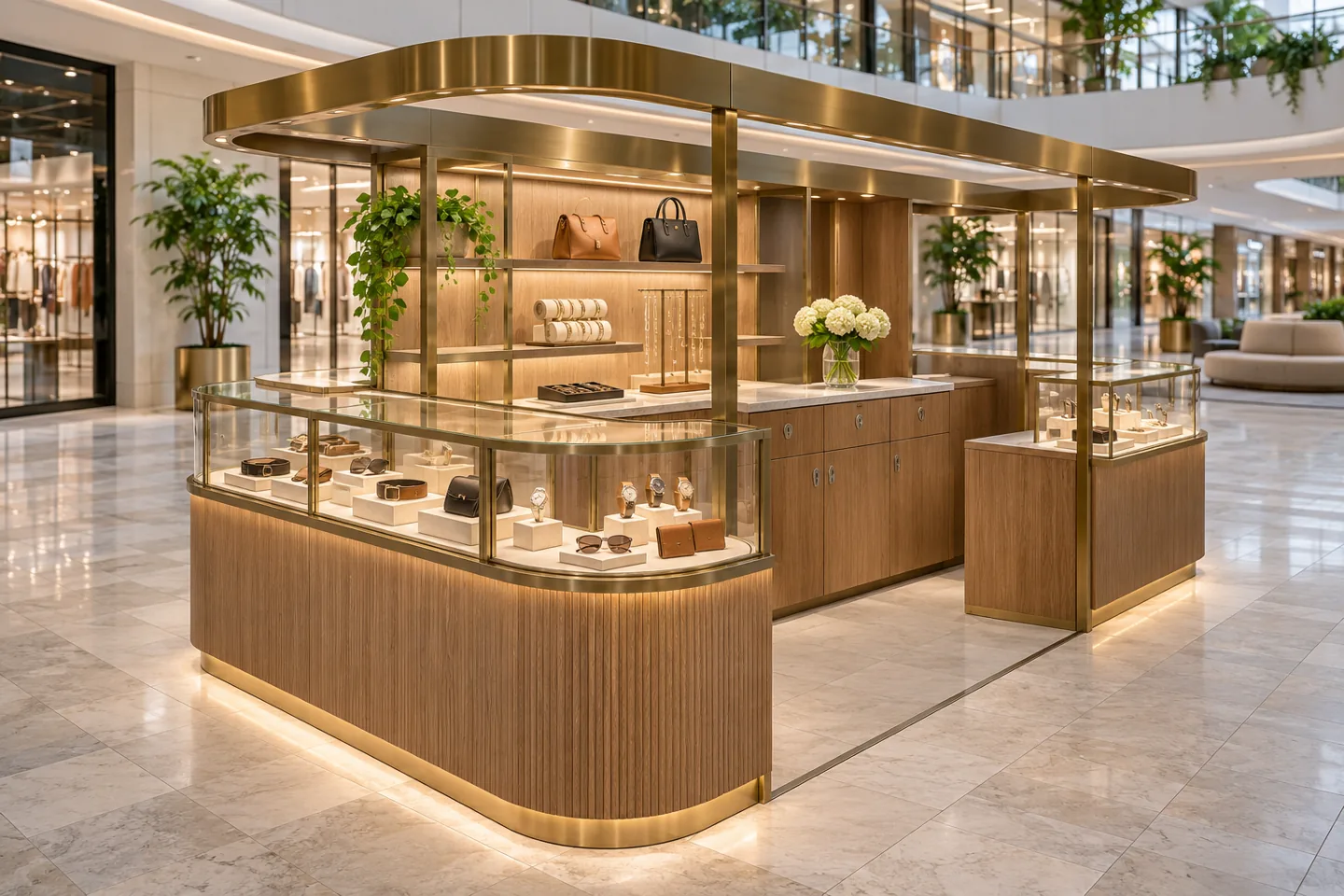
Describe the tasks staff perform at the kiosk: greeting, demonstrating products, processing payments, packaging purchases and replenishing displays. Confirm the actual devices and stock containers before fixing cabinetry. A compact counter can quickly become crowded when an attractive presentation omits the equipment and materials needed during a trading day.
Review internal compartments, access panels and the operator’s closing routine through the shop drawings. Identify which items remain secured and which are removed each evening. Keep their handling and storage arrangements explicit. Decisions on security systems and operating procedures remain with the operator and appointed specialists; the interior package coordinates the agreed physical interfaces.
Build a display specification around real merchandise
Use representative product dimensions, quantities and packaging to test the display proposal. Confirm the surfaces, shelves and holders actually included rather than pricing an undefined visual impression. Ask who accepts the product arrangement and which elements may change during the activation. A kiosk selling a small number of large items has different storage and presentation needs from a dense range of small accessories.
For interchangeable display pieces, agree how they are attached, removed and stored without damaging retained finishes. Define the product information the fabricator needs and the relevant suitability reviews. If merchandise changes after acceptance, assess the effect before adding fittings or equipment. A larger display should not quietly extend beyond the venue-approved position or obstruct a service access point.
Resolve connections and disconnecting responsibilities together
List every included electrical, data or other service interface and the nominated equipment connected to it. Obtain the current requirements from the appointed engineers, venue and vendors. CBD can coordinate the accepted interior arrangement with those inputs; technical design, authorised connection work and testing must remain with the appropriately appointed parties.
The same responsibility schedule should explain what happens at removal. Identify who isolates, disconnects and makes safe each interface and what the venue expects to receive afterwards. The interior team should not assume a vendor will return simply because it attended the installation. Include any agreed specialist attendance and close-out information in the proposal, with exclusions visible before the operator commits.
Use samples to settle repeated high-contact details
Ask the operator to identify the edges, counter surfaces, display fronts and other elements customers or staff will repeatedly touch. Review identifiable finishes and representative junctions before production. Agree the appearance, preparation and care information required for acceptance. Avoid unsupported claims that a selected material is indestructible, universally compliant or maintenance free.
For temporary work, discuss how branding and protective layers will be removed without an unexplained repair liability. A finish that looks suitable during the launch may be difficult to refurbish for a second campaign. Record accepted references and replacement information so later repairs can be evaluated against the actual specification rather than an old photograph or an approximate colour description.
Bring your brief into focus
Share your Abu Dhabi kiosk location, product brief and intended installation and removal arrangements for an initial consultation.
Send your project briefCoordinate signage as a separate acceptance interface
Confirm what is fixed branding, what is a changeable campaign element and what another vendor supplies. Obtain the actual artwork and equipment details at the right stage. The shop drawings should show the accepted relationship between signs, counter construction, visible cabling where relevant and maintenance access, with technical work allocated to responsible specialists.
Ask the operator and venue to establish the permissions applicable to the proposed sign or promotional activity. An interior fabrication drawing is not itself permission to advertise. If branding changes during the trading period, check whether the physical work, venue acceptance or other project information must be reviewed. Keep that decision separate from simply approving the appearance of new artwork.
Plan installation as a controlled venue activity
Confirm delivery bookings, access attendance, approved working arrangements and protection with the actual venue management team. Break the installation into understandable activities: receiving components, assembly, specialist connections, inspection, cleaning and the operator’s stock placement. Name the responsible party for each task and identify the information needed before it can begin.
Agree how packaging and surplus materials leave the venue and where anything temporarily retained will be held. If one supplier misses its attendance, explain which later tasks become dependent on its return. A programme should make those interfaces visible rather than label an entire night as installation and leave the operator to discover incomplete work when staff arrive to trade.
Define support during the trading period
Agree what the construction appointment includes after handover. A fabrication defect, accidental damage, a campaign alteration and a device fault may involve different responsible parties. The operator needs a clear contact route and an understandable basis for assessing the issue. Do not advertise unlimited callouts or guaranteed response periods unless the actual contract provides them.
Retain product references and access information with the operating team. Identify changes that need design or technical review before staff or a third-party vendor modifies the assembly. For a repeated activation, record useful observations about access, replenishment and maintenance. Those observations can improve a later proposal without becoming invented evidence that the same kiosk will work unchanged at another property.
Price removal, storage and reinstatement visibly
The construction price depends on the assembly, finishes, nominated equipment, site access, specialist attendance and the completeness of accepted information. A temporary project also needs clear allowances or exclusions for dismantling, packing, transport, storage and venue reinstatement. Ask who decides which components are retained and who accepts the condition of items handed back.
Record the agreed return condition of the venue area before work starts. At removal, distinguish pre-existing condition, damage associated with installation and the scope of making good. The relevant parties should accept any repair method affecting retained surfaces. CBD can review the proposed life of the kiosk and define its appointment; this page supplies no invented turnkey rate, permit period or approval guarantee.
For components being stored, agree a simple identification record linking each package to the assembly drawings. Identify loose hardware, fragile display pieces and any vendor-owned equipment returned separately. Record the condition when components leave the venue and when the receiving party takes possession, so later refurbishment discussions start from evidence rather than assumptions.
Start with the venue and trading brief
Send the Abu Dhabi location, approved position information, product range and intended trading arrangement. Include available venue instructions, connection details, artwork and information about operator-supplied devices. Explain whether the kiosk will be retained, relocated or removed, together with the investment direction and the people authorised to accept decisions.
Use our project brief form for an initial consultation and suitability review. CBD Projects can discuss the construction package and identify the information required for a concrete offer. For a wider brand programme, our UAE kiosk design service addresses common design references. A separate Dubai kiosk appointment needs its own venue and delivery arrangements.
Frequently asked questions
Can you adapt a kiosk intended for another venue?
It can be assessed as a starting point. Review its actual dimensions, condition, component connections and current venue requirements. Reuse is a project decision, not automatic acceptance. Identify what must change before assuming a stored kiosk is ready for a new Abu Dhabi location.
Does commercial permission replace installation approval?
No such equivalence should be assumed. The operator and relevant advisers should confirm the applicable business and venue requirements, while technical and contractor-access arrangements remain separately identifiable. CBD’s agreed detailing and application coordination do not guarantee authority acceptance or permission to trade.
Can a Dubai-based contractor consider the kiosk?
When reviewing interior fit out companies in Dubai for an Abu Dhabi kiosk, compare the actual site attendance, logistics, project eligibility and specialist appointments included. CBD Projects LLC is Dubai-based and considers selected Abu Dhabi enquiries after that review; no local branch or blanket registration is asserted.
Can removal be included from the first quotation?
Yes, where the scope defines dismantling, specialist disconnections, packing, transport and the agreed venue return condition. Identify assumptions and exclusions, including storage or later reinstallation. This helps the operator compare the complete construction appointment rather than only the initial assembly cost.