
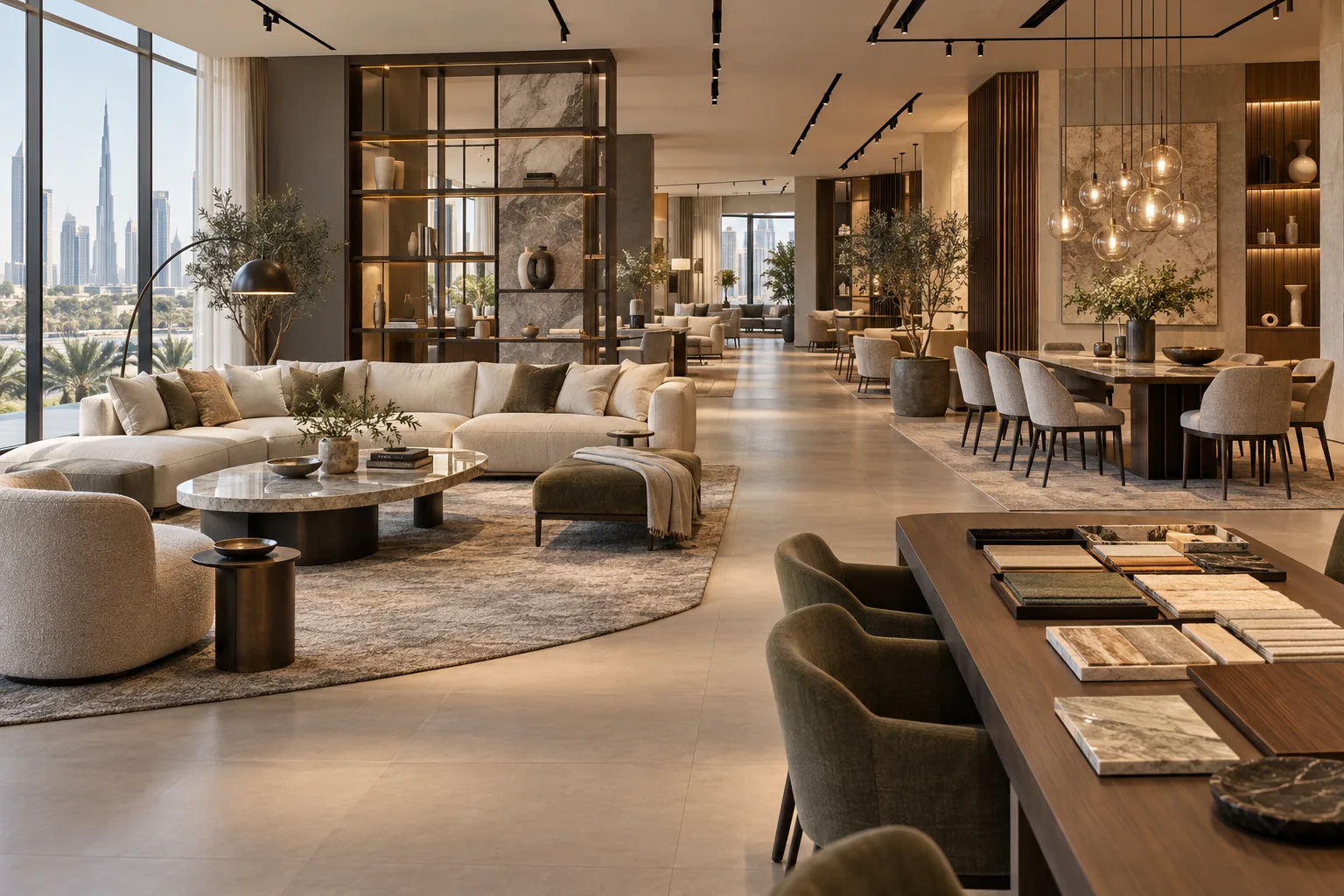
Showroom interior design concept for context; not a completed photography installation.
Agree the image output and operating sequence before choosing a permanent or convertible photography setting.
A retailer wants its staff to photograph new products for online listings, customer messages and social channels without closing a display bay every time. The task starts on a spare counter, then spreads into the stockroom as lights, backgrounds and boxes accumulate. The business may not need a professional photography studio, but it does need a defined arrangement if product images are part of normal store work.
Before adding a photography corner to a Dubai shop fit-out, describe the products, users and publishing process. CBD Projects can coordinate the physical provision within a retail interior design scope. The owner and its creative or photography specialist should define the image requirements; the interior team can then plan the space and interfaces that support them.
This is a commercial shop-planning question, not a promise that a particular fit-out will improve online sales or produce professional images automatically. A modest task area can be useful when it has a clear operating brief. An elaborate installation can be wasteful when nobody has established what needs to be photographed or who will use it.
Jump to a section 11 topics
Identify the image task before selecting equipment
Ask what the images are for and how consistent they need to be. A quick customer reference photograph differs from a catalogue image with an agreed background, crop and colour expectation. The owner should confirm the required output with its creative team before an installer is asked to select lights and finishes based on appearance alone.
List who takes the photographs, what device they use and how the image is reviewed. A setting used by one experienced person can operate differently from a shared station used by several sales staff. Record the approved example or technical brief that defines a successful result. The fit-out team does not need access to private customer conversations or unpublished commercial campaigns merely to understand the spatial requirement.
Use the largest relevant product as a planning reference
Identify the range of products the setting will genuinely accommodate. Jewellery, footwear, a chair and a large decorative object require different surfaces, backgrounds and working distances. Decide whether unusually large items will be photographed elsewhere rather than forcing a small store to accommodate every possible object permanently.
Give the designer real product dimensions and a representative sample where practical. Include packaging if opening, styling or repacking is part of the task. Review how the person taking the photograph moves around the product and where accessories are placed during the session. The work surface is only one part of the required area. A table that fits the object but leaves no usable camera position has not resolved the brief.
Compare a permanent station with a convertible setting
A permanent location may provide consistent availability and a simpler reset. A convertible arrangement may preserve selling or support space when photography is infrequent. Compare the actual setup time, storage requirement and interruption to other tasks. Do not assume that a foldaway surface removes the need to store backgrounds, lighting and accessories elsewhere.
Ask the team to describe how the arrangement changes from normal store use to photography and back again. Identify every object moved, its temporary location and who performs the task. A convertible setting is credible when that sequence is practical, not merely when a drawing shows two different furniture states. If the setup would repeatedly block stock access or require moving a display, the business should understand that burden before choosing it.
Separate the station from the customer journey
Review the photography task alongside a busy shop period. Products waiting for photography, open cartons and temporary backgrounds can create a different visual impression from the accepted retail display. Decide whether customers should see the activity, whether it belongs behind the scenes or whether a controlled visible process suits the brand.
Keep the movement of staff and products clear on the plan. A camera position should not depend on standing in a customer route or occupying another person's working space. The responsible project team must review access and other applicable requirements for the actual premises. If the proposed setting interferes with a required route or facility, redesign the arrangement rather than relying on a promise that photography will always happen at a quiet moment.
Review light with the photography specialist
The store's display lighting and the photography task may have different objectives. Ask the creative specialist to identify the relevant image requirements and suitable equipment. The interior team can coordinate mounting, storage, surfaces and building-service interfaces around that information. Decorative lighting selected for a retail display is not automatically a controlled photographic setup.
Consider whether daylight or neighbouring lighting changes the setting during the day. Review the intended background and product types through an appropriate trial. Highly reflective, transparent or unusually coloured products may expose limitations that are invisible in a general interior rendering. Avoid promising colour accuracy or consistent catalogue results from the fit-out alone. The owner needs a workable photography process as well as coordinated physical provision.
Define the background and its reset method
Ask whether one background serves the product range or whether different surfaces are required. Identify how backgrounds are supported, changed, stored and cleaned. A loose sheet propped against a wall might appear adequate in a test photograph but create repeated handling difficulties in daily use. The accepted arrangement should match the frequency and type of work.
Show the relevant dimensions, fixings and finishes in the design information. Where an item is supplied by the creative specialist, record that interface rather than assuming it belongs in the joinery price. Consider what happens when a background is damaged or replaced. A visually seamless permanent construction may be less useful than a replaceable component if the operation regularly marks or changes the surface. Compare the complete use and maintenance cycle.
Give products a place before and after the photograph
List the stages around the image itself: selecting stock, checking its condition, preparing it, photographing it, confirming the result and returning it to the correct location. Provide an appropriate temporary allocation so that photographed and unphotographed items do not become mixed. The owner should define any handling or stock-control process needed for the products concerned.
Do not count a neighbouring packing bench as permanently available if it already has another busy function. Show how the station works while ordinary store tasks continue. If the business intends to batch photographs outside customer hours, record that assumption and review whether preparation and reset also fit that period. The design should support an accepted operation rather than hide its space needs inside another department's allocation.
Coordinate power, connections and equipment storage
Provide the electrical team with the actual equipment brief and identify any changes still awaiting specialist selection. Show relevant device, charger and lighting positions with the furniture arrangement. Avoid a layout that relies on temporary cables crossing a working route. The responsible professionals must determine the appropriate installation for the project; a fit-out article is not an electrical design specification.
Include where equipment goes when not in use. Tripods, stands and cases can occupy more space than their appearance in a photograph suggests. Clarify whether storage needs adjustable supports, labelled compartments or a simple dedicated area. The fit-out proposal should show these provisions rather than leave the owner to find a location after installation. Equipment supplied directly by the owner still needs its dimensions and interfaces coordinated.
Run a small trial before releasing fabrication
Use representative products and the proposed photography method to test the important decisions. The trial should answer defined questions: is the working depth adequate, can the camera reach the intended position, does the background suit the product range and can the area reset without disrupting another task? Agree who accepts the result.
A useful trial does not need to become an expensive showroom installation. The appropriate scope depends on uncertainty and the cost of changing the final work. Retain the accepted dimensions and equipment references, then carry them into the coordinated drawings. If the trial exposes a limitation, decide whether to revise the setting or narrow its intended use. Do not approve an arrangement for every product when the trial only demonstrated one small item.
Ask bidders to price the same operating arrangement
When comparing retail fit out companies in Dubai, provide the same product range, equipment references, accepted layout and supplier responsibilities. Identify whether backgrounds, specialist lights, software or photography training sit outside the interior contract. A low quotation based only on a counter cannot be compared fairly with a proposal including coordinated equipment storage and mounting interfaces.
The cost depends on retained conditions, joinery, finishes, services and the specialist equipment actually selected. A truthful proposal should state what the fit-out enables and what remains dependent on the retailer's creative process. CBD Projects can review the scope through a free initial consultation. Bring the shop plan, sample products and intended image output so the discussion can focus on a useful task area rather than an unsupported promise of a complete professional studio.
Keep the setting consistent after opening
Provide the store team with the accepted setup and reset information within the agreed handover scope. Identify where movable items belong and which components should not be repositioned casually. If creative requirements later change, review the equipment and spatial consequences together rather than adding successive accessories until the original setting becomes unusable.
Use actual experience to decide whether the task needs a larger area or a different process. A store might discover that certain items are better photographed elsewhere while everyday products work well in the fitted setting. That is a useful operating distinction, not a failure to photograph everything on site. Retain the station's intended scope so that future staff and suppliers understand the arrangement they are inheriting.
Frequently asked questions
Do we need a separate photography room?
Not necessarily. Compare frequency, product sizes, setup time and interference with other activities. A defined task area may suit some retailers, while others need a more controlled separate setting. The decision should follow the actual image brief and premises rather than a generic studio label.
Can our normal display lighting be used?
Ask the photography specialist to test it against the intended output and product range. Display lighting is selected for a different experience and may not provide the consistency needed for the images. Coordinate any additional equipment with the interior and electrical design before purchasing or installation.
Will a photography corner increase sales?
No sales outcome is established by installing one. It can support an agreed image-production process, but results also depend on products, creative execution, publishing and customer demand. The project brief should describe a useful operational benefit without turning that benefit into an unsupported revenue guarantee.
What is the first information CBD needs?
Provide the shop plan, relevant product dimensions, candidate equipment and an example of the required image output. Explain who will use the station and how often. Mark unresolved creative decisions so the design appointment can identify what needs specialist input before the physical setting is finalised.
Plan your retail project with one accountable team
Send the premises plan and your operating brief to CBD Projects for a free initial consultation and an agreed design scope.
Send Your Project BriefBack to BlogRelated ServiceView Real ProjectsContact CBD Projects