

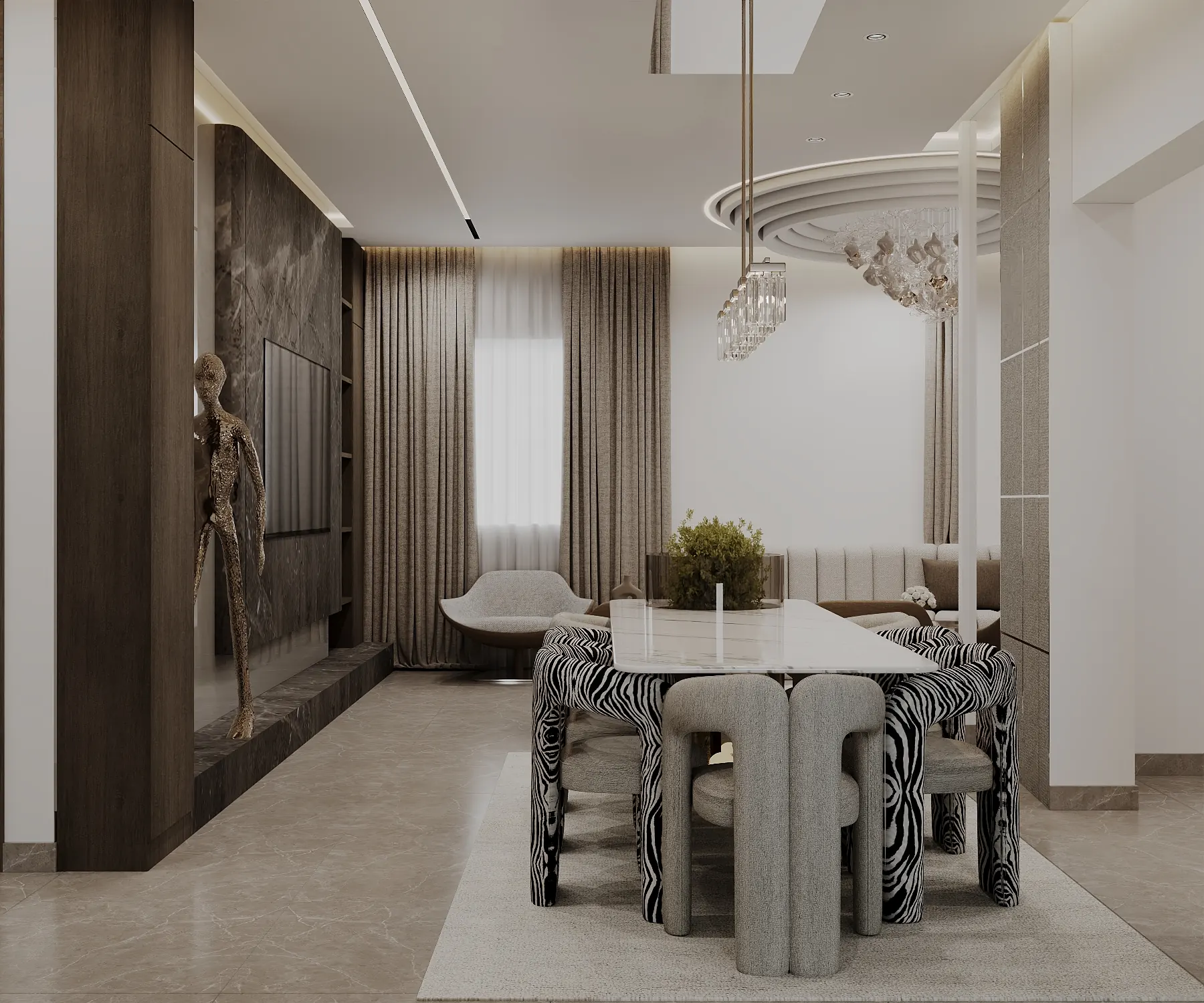
A luxury residential interior from the CBD Projects portfolio.
Approve each material for a named location and exposure. Judge a finish using a representative sample, a full-size edge or joint, the proposed cleaning method and a plan for repair. Spend on the surfaces the household touches or sees closely, and simplify the background finishes that connect the rooms.
Place a stone tile, a piece of veneer and a brass swatch on a table and almost any combination can look convincing. Now ask how those pieces meet where the kitchen island turns a corner, how a cleaner will remove a tea stain and what happens when a drawer front gets chipped. Those questions lead to a more useful materials brief for a Dubai villa than a list of luxury brands.
Jump to a section 13 topics
Begin with one walk through the villa
Walk from the front door to the dining table, then out to the terrace. Mark every change underfoot and every surface seen beside another. A hallway tile and a living room slab may have been chosen in different showrooms but will read as a pair at the doorway. A thin metal strip can make a deliberate transition; repeated strips at every minor change can make a generous floor feel fragmented. Decide where a break belongs before comparing individual products.
Bring the household into this walk. Ask who enters from the garden with wet feet, which table doubles as a homework desk and where a vacuum is usually parked. Use those answers to distinguish a display surface from a working one. A textured stone panel behind art raises different questions from the same surface on a breakfast ledge where milk can run into the pores.
Choose the island by deciding how you want it to age
Compare a veined natural stone with a manufactured slab suitable for the proposed application. With natural stone, inspect the actual slab, not just a polished chip. Mark the sink, hob and proposed joints on its image. A striking vein through the centre of a sample might disappear in the sink cut-out. With a manufactured slab, ask to see the edge and a return: the face pattern may not carry through the thickness as you expect.
Make a practical choice about patina. If the owner wants a pristine breakfast counter with minimal fuss, request the supplier's written care limits and test representative offcuts with ordinary food and the permitted cleaner. If the owner likes a surface that records use, explain what local repair can and cannot disguise. Ask the fabricator to show the proposed edge next to a cabinet door; thickness, overhang and shadow can change the appearance more than switching to a rarer slab.
| Sample | What it tells the owner | What still needs checking |
|---|---|---|
| Small stone chip | Colour family beside the cabinet finish | Slab variation and the vein at the sink opening |
| Full slab photograph | Where cuts interrupt the pattern | Actual sheen and edge appearance in the room |
| Fabricated corner | Thickness and the junction between face and return | How the selected cleaner affects a representative offcut |
A wardrobe door and a vanity door need different specifications
A timber colour is not a construction specification. Identify what carries the finish, what closes the edges, how the back is finished and what happens at screw holes, pulls and corners. On long banks of wardrobe doors, ask for an elevation showing leaf sequence and grain direction. Number the doors before delivery. An attractive replacement door from a later batch may stand out if nobody recorded the original sequence.
For a vanity, focus instead on exposed edges near the basin, cleaning around the plinth and the route a small leak would take before anyone sees it. A raised base can make the floor easier to inspect but may expose the underside to view from the bath. A closed plinth hides pipework but needs an agreed means of access. Compare the two in section at real scale. The home joinery guide explains what the shop drawing should show behind the finished face.
Read sheen from where people sit
Take a vertical sample to the wall and put a horizontal sample on the floor; a flat tray cannot reproduce both viewing angles. Look across the floor towards the brightest window, then switch on the proposed evening lamp. A satin floor can show a strong reflection under grazing light. That may enliven a quiet entrance but distract from art in the next room. Evaluate the finish with the intended lighting, not with the brightest light available.
Hang a generous piece of curtain fabric folded, with its intended lining. A tightly stretched square says little about the shadows in a full drop. Hold the upholstery against it and check the side exposed to daylight as well as the side facing the room. Ask the supplier for product-specific care and exposure information. Where replacement would be difficult, favour removable covers or repeatable modules and set aside the exact fabric reference.
Resolve the transition at the terrace
A matching indoor and outdoor colour does not require an identical surface finish. Compare a visually related exterior product against the actual demands of weather, wet use, cleaning and replacement. Ask the design team for the threshold detail showing door operation and drainage before approving the tile grid. A continuous line drawn through a door is only an aesthetic intention until the build-up and joint positions have been coordinated.
For metal handles and trims, request the base material, finish process, permitted exposure and supplier care instructions. Compare a concealed fixing with an exposed fixing that can be reached later. If an exterior handle must be replaced, it helps if the fixing centres and finish reference are known. Keep a marked sample in the handover box rather than expecting a colour name to identify the part years later.
Sign a piece of the finished room
Commission one representative junction where several decisions meet: cabinet face, handle, worktop, splashback and under-cabinet light. View it standing and seated, wipe the surfaces and open the drawer. Note the agreed edge, grain direction, gap, sheen and sealant colour. Photograph it, give the physical sample an identifier and circulate the same record to the designer, supplier and installer. If an item is substituted, review its neighbours as well.
Set a hierarchy of surfaces before making substitutions
Identify the surfaces that establish the character of the home and those that support them. A carefully chosen entrance floor, stair enclosure or dining wall can carry a strong identity while secondary rooms use a quieter repeatable palette. Mark those priorities on the room schedule. This gives the owner a reasoned way to simplify procurement when availability changes without making every room compete for attention.
In a hypothetical villa, the owner prefers a distinctive dining-wall stone but receives a more expensive option for every bathroom. Compare retaining the principal feature with simplifying bathroom backgrounds, using products the responsible designers and suppliers consider suitable for those locations. Review the complete combination rather than agreeing substitutions one purchase at a time. A saving has design value when it preserves the intended hierarchy; repeated minor changes can otherwise leave several nearly matching materials with no clear relationship.
Approve the size of variation the owner is willing to see
Natural variation and manufactured repetition both deserve deliberate review. Ask the supplier to show a range representative of what will be delivered, including pieces that differ most visibly. Decide where variation contributes to the room and where adjacent pieces need closer selection. An owner who enjoys an irregular feature wall may still want a calm bedroom floor. Put that distinction into the allocation and installation instructions.
For repeating manufactured patterns, inspect how the proposed units are arranged across a larger area. A small sample cannot reveal an obvious motif appearing several times in a sightline. Ask the installer for an intended setting-out arrangement using actual product information. At the review, distinguish an aesthetic preference from a technical installation requirement. The approved reference should let the supplier understand the appearance being purchased without promising a level of uniformity that the product cannot reasonably provide.

Compare handles with the objects that touch them
Bring the selected handles, switches and visible metal accessories together on a sample surface. Decide whether they should match closely or deliberately differ. A brushed handle and a satin switch may share a colour description yet look unrelated under the same light. Focus on elements seen together from normal positions rather than insisting that every metal throughout the villa use an identical finish name.
Try the handle on a representative door or drawer, with the intended user. Check how jewellery, fingernails or ordinary cleaning reach the recess. Ask the supplier for the exact product and care information, including whether a component can be replaced individually. Avoid basing the decision on a loose swatch whose finish process differs from the ordered hardware. These small touch points often contribute more to the daily impression of quality than a distant decorative surface.
Decide what the owner expects a local repair to look like
Request examples of the supplier's proposed repair method for a representative finish, where available. Ask what a repaired edge or replacement panel is likely to look like beside the original work. This is a practical appearance conversation, not a guarantee that any future damage can be made invisible. Record what the owner accepts and where replacement would be preferable to repair.
Consider the most exposed locations first: the corner of an island, the edge beside a frequently used door and the base of a cabinet receiving cleaning contact. Compare a detail that expresses a replaceable component with one that creates an uninterrupted surface. The latter may be aesthetically important; it may also require a larger replacement if damaged. The owner should choose with that consequence understood rather than discover it only after a small chip interrupts a prominent finish.
Order spare material for identifiable uses
Agree the purpose of any spare stock before ordering it. A replacement tile, a short length of special trim and a veneer offcut support different repairs and need different identification. Ask the supplier and installer what is practical for the selected assembly. Avoid an arbitrary spare percentage that produces unusable fragments while omitting the component most likely to be difficult to obtain later.
Label retained material with its product reference, location, batch information where relevant and storage guidance. Identify who receives it and where it can be kept without damage. For distinctive natural pieces, retain the allocation record as well as an offcut. A future repair team needs to understand what was installed, not simply find an unmarked box described as villa spares. This makes the material investment easier to maintain without filling the home with unidentified remnants.
Keep furniture procurement connected to the finish decision
Before releasing major loose furniture, compare its feet, upholstery and overall finish with the approved floor and adjacent cabinetry. Ask about protective interfaces and product-specific care needs. An independently selected chair can introduce an unexpected metal tone or a contact detail the floor supplier needs to consider. Coordinate the actual items while changes are still possible, rather than asking styling accessories to reconcile a combination the project never reviewed together.
Check a sample that has been handled
Compare the pristine reference with a representative sample that the supplier has prepared for ordinary handling and approved cleaning demonstrations. Ask which changes in sheen or appearance are expected and which would need investigation. The purpose is to understand the selected product's character before ordering, rather than make an unsupported durability prediction from one informal trial.
Frequently asked questions
Should all stone in the villa come from one batch?
Prioritise surfaces seen together. For natural material, inspect and allocate actual pieces so the installer knows which slabs meet across a return or doorway.
Where can I simplify without losing the design?
Try a quiet, repeatable background floor and reserve the distinctive slab for one surface with uninterrupted viewing distance. Test the combination on site before committing.
What material records should I keep?
Retain approved references, batch details, care instructions, a labelled offcut where practical and a drawing showing the location of special joints or concealed access.
Plan your villa interior design project with one accountable team
Ask CBD Projects to turn your villa finish shortlist into a room schedule and identify the first junction worth mocking up.
Send Your Project BriefBack to BlogRelated ServiceView Real ProjectsContact CBD Projects