
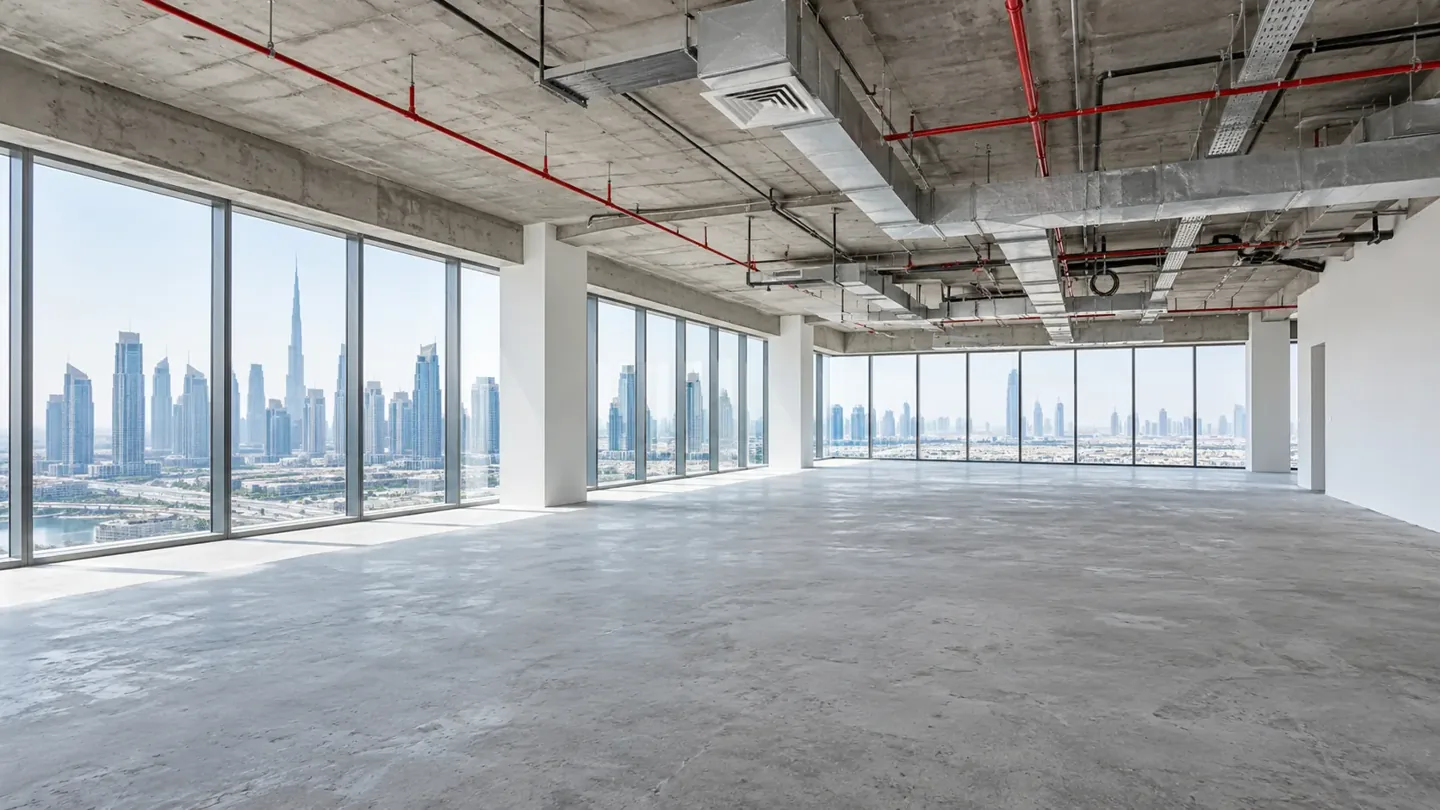
Office shell reference for reviewing the information behind provisional quotation items.
Provisional items in a Dubai fit-out quotation deserve attention before the client compares the total with the available budget. An allowance can identify work that belongs in the project while acknowledging that its specification or extent remains incomplete. The important question is what information will turn that entry into an accepted item that can be purchased, installed and reviewed.
This guide focuses on that individual decision route. It is separate from holding a contingency for wider project risks or comparing every line of competing tenders. When reviewing fit out companies in Dubai, ask each team to explain the work assumed, what remains unresolved and how the final selection will be incorporated. The terminology and commercial procedure need to be understood within the actual project documents.
Jump to a section 16 topics
Start with the work behind the amount
Choose one provisional entry and identify the physical work it is intended to cover. A line described only as reception feature, lighting or joinery does not give the client enough information to understand the allowance. Ask which room, assembly and extent are assumed, then connect the answer to the relevant drawing or brief.
The purpose is to make the uncertainty visible. A reception desk awaiting a finish selection is different from an unmeasured alteration to retained construction. Both might appear under an allowance heading, but the missing information and the route to a reliable price are different. Record that distinction before comparing amounts.
Ask why the item is still provisional
Identify the unresolved decision rather than accepting provisional as a permanent description. The design might be incomplete, a product might remain unselected, quantities might require verification or a specialist might need to examine an interface. Knowing the reason helps the client decide what can reasonably be resolved before an appointment is made.
Assign the next action to a named role. The owner may need to select a finish, the designer may need to issue a detail, or a specialist may need to supply technical information. A general instruction to finalise later gives nobody a clear task and leaves the quotation dependent on the same unanswered question.
Read the terminology within the actual proposal
Commercial documents do not always use allowance, provisional sum and approximate quantity in the same way. Ask the bidder and your appointed advisers to explain the meaning used in the particular proposal. Record how the amount will be replaced, adjusted or reconciled when the missing information becomes available.
RICS publishes measurement guidance that distinguishes different provisional work descriptions. It is a useful terminology reference, but its rules should not be assumed to govern every Dubai fit-out appointment. The agreed project documents and appropriate professional advice establish the actual commercial mechanism. This article concerns a client review process rather than interpretation of contractual rights.
Separate a work allowance from your contingency reserve
A provisional work item concerns an identified portion of the proposed project that still needs definition. A client's contingency may address wider uncertainty or the possibility of future events. Keep those purposes separate in the budget discussion, even if both appear as amounts that have not yet become final expenditure.
For example, an allowance for a particular display assembly should not be treated as unrestricted money available for unrelated upgrades. Likewise, a reserve held by the client should not conceal a known necessary item missing from the quoted scope. Ask your cost adviser to show how the categories relate without counting the same expected work twice.
Describe the assumed specification before comparing allowances
Ask for the material or performance assumptions behind the allowance. A joinery item can vary with dimensions, internal fittings, finish, support, hardware and service access. A product photograph may communicate appearance but leave several of these factors unanswered. Identify which assumptions support the amount and which remain open.
When discussing joinery fit out companies in Dubai, compare the specification boundary as well as the allowance itself. A proposal allowing for a simple assembly cannot be compared directly with one that anticipates a more complex accepted detail. Use the review to establish a shared description before interpreting the difference as a saving.
Check the quantity and measurement basis
A client should understand whether the entry assumes one item, a stated area, a length or another identifiable quantity. Ask which drawing issue supports that quantity and who will verify it. Where site measurement remains necessary, record when it can happen and what conditions must exist for a useful measurement.
A stated quantity can be provisional even when the unit description is clear. Conversely, a measured area does not settle an unresolved specification. Keep those two questions separate so a later explanation of increased cost identifies what actually changed. This also helps the team recognise which parts of the amount can become firm before the remainder is resolved.
Find the adjoining work that the amount depends on
Follow the item to its edges. A specialist counter may need a prepared base, adjacent finishes and coordinated service positions. A decorative fitting may depend on supports, controls or access. Ask which of these interfaces are within the allowance and which are already included elsewhere in the proposal.
The interior fit-out contractor should identify the information needed from other parties before the item can be ordered or installed. The client can then check that the project contains a continuous scope rather than several separate allowances with gaps between them. Record each interface against the actual assembly instead of relying on an undefined turnkey description.
Confirm the treatment of supply and installation
An allowance may cover purchasing a product without covering every task needed to make it usable. Ask about delivery, receiving, storage, assembly, installation, connection, protection and completion records where relevant. Establish which tasks are included in the item, which appear elsewhere and which require a separate appointment.
If you intend to buy the product directly, review the consequences before removing an allowance from the offer. The purchase price may leave other responsibilities unchanged, while the supplier's installation offer may overlap with existing work. A clear comparison describes the complete intended arrangement rather than assuming that a direct purchase removes the whole construction package.
Identify what can be decided before the site programme starts
Prioritise items that influence concealed work, service locations or bespoke fabrication. A late choice can affect several trades even if its purchase price is modest. Ask the designer and contractor which information must be accepted before related work proceeds, then give the client a decision date tied to that dependency.
For office fit out in Dubai, a meeting-room furniture allowance might remain open while its service interfaces already need coordination. Confirm the dimensions and functional requirements that can be fixed now, and identify what genuinely remains selectable later. The aim is to manage an incomplete item deliberately rather than allowing every associated decision to drift together.
Ask how a completed selection becomes a revised price
The review should establish the documents needed to replace the provisional description. These might include an accepted drawing, supplier quotation, measured quantity, material reference or specialist scope. Ask who gathers the information, who reviews it and how the revised amount is presented to the authorised client representative.
Keep the original allowance visible beside the proposed replacement so the client can understand the movement. Request a clear explanation of additions, omissions and changed assumptions, using the agreed commercial procedure. The comparison should make the decision understandable; it should not ask the client to infer the reason for a new amount from a supplier attachment alone.
Review the programme effect with the cost decision
A replacement item may have a different lead time, installation sequence or access requirement from the original assumption. Ask the team to describe those effects alongside the revised amount. A client accepting a product should understand whether the choice affects an order date, a room completion or another package.
Do not assume that an unchanged allowance means the programme remains unchanged. A similarly priced alternative can still need different dimensions or coordination. When comparing interior design and fit out companies in Dubai, ask how their decision process connects purchasing information with construction planning so that the client receives one coordinated recommendation.
Keep options separate from necessary work
An optional enhancement should be identified as a choice, while a required item must have a credible route to completion. Ask what happens to the intended operation if the provisional item is omitted. The answer helps distinguish a genuine discretionary feature from an unresolved part of the basic project brief.
If the owner defers an optional element, identify any enabling work that still needs to be decided now. A later display installation, for example, might have an interface with today's finished surfaces. Record the accepted boundary and the effect of postponement. That makes the choice deliberate without commissioning speculative construction merely because an allowance once appeared in the estimate.
Use an item register that supports an actual decision
Give each provisional item a reference, location, original assumption, missing information, responsible role, target decision date and current pricing status. Add the accepted replacement reference when the decision is made. A simple maintained register is more useful than a detailed table whose entries have no owner or next action.
Keep the register connected to drawing issues and the quotation revision. If an entry changes after a client meeting, record which instruction caused the update. The client should be able to follow one item from its initial allowance to its accepted scope without searching through unrelated messages or relying on someone's recollection of a conversation.
Test the proposal with one representative item
Before accepting a large group of provisional entries, ask the team to walk through one example in detail. A bespoke reception feature or selected light fitting can reveal whether quantities, supply boundaries, specialist input and the pricing procedure are sufficiently clear. Use an actual proposed item rather than an invented price illustration.
The exercise is a practical way to evaluate communication between the interior design consultant and construction team. If the parties cannot explain how one ordinary allowance will become a coordinated order, request clarification before applying the same uncertain approach throughout the project. A good review produces a repeatable decision route, not additional promotional wording.
Close the allowance when the agreed item is completed
At completion, the project record should identify the item actually supplied and the relevant accepted scope. Check that its reference connects with product information, warranties or operating records included in the appointment. Any remaining commercial reconciliation should follow the agreed process with the responsible professional team.
Keep outstanding selections distinguishable from installed work awaiting review. A room can appear finished while an allowance entry remains unresolved in the records. Closing both the physical and information tasks helps the owner understand what was received, what remains open and who is responsible for the next step. It also creates a clearer starting point for later maintenance or alteration.
Prepare your provisional-item questions before requesting a proposal
Share the current plans, intended use, known selections and items that remain undecided. Tell the team where you need alternatives and where a particular result is essential. CBD Projects LLC can discuss an appropriate interior scope and the information needed to develop identified items responsibly.
Use the project brief to provide that starting information. Our commercial fit-out service explains the wider construction scope, while the fit-out contingency guide addresses the separate question of managing project uncertainty. Reviewing provisional items should help you make a defined selection, understand its consequences and issue a clear accepted instruction.
Frequently asked questions
Does a provisional amount establish the final price?
It identifies an allowance within the particular proposal. Ask your appointed advisers and the bidder to explain the agreed adjustment procedure and the information needed to establish the actual item price.
Is a provisional work item the same as contingency?
Keep an identified work allowance separate from the client reserve for wider uncertainty. Ask the cost adviser to explain how both appear in the project budget without counting the same work twice.
Can we leave every selection until construction starts?
Some choices affect drawings, concealed work or procurement before installation begins. Ask the team for decision dates linked to those dependencies and clarify what can safely remain undecided.
What should accompany a revised allowance price?
Request the accepted item description, supporting quantity or supplier information, comparison with the original allowance and any programme consequences, presented through the agreed decision procedure.
References and scope
References checked on 23 November 2026. Confirm current requirements and product instructions for the actual project; these links do not constitute project approval.
Plan your interior project planning project with one accountable team
CBD Projects LLC provides interior design and fit-out coordination across Dubai and the UAE. Share your space, location, target opening date and budget range for a practical first review.
Send Your Project BriefBack to BlogRelated ServiceView Real ProjectsContact CBD Projects