
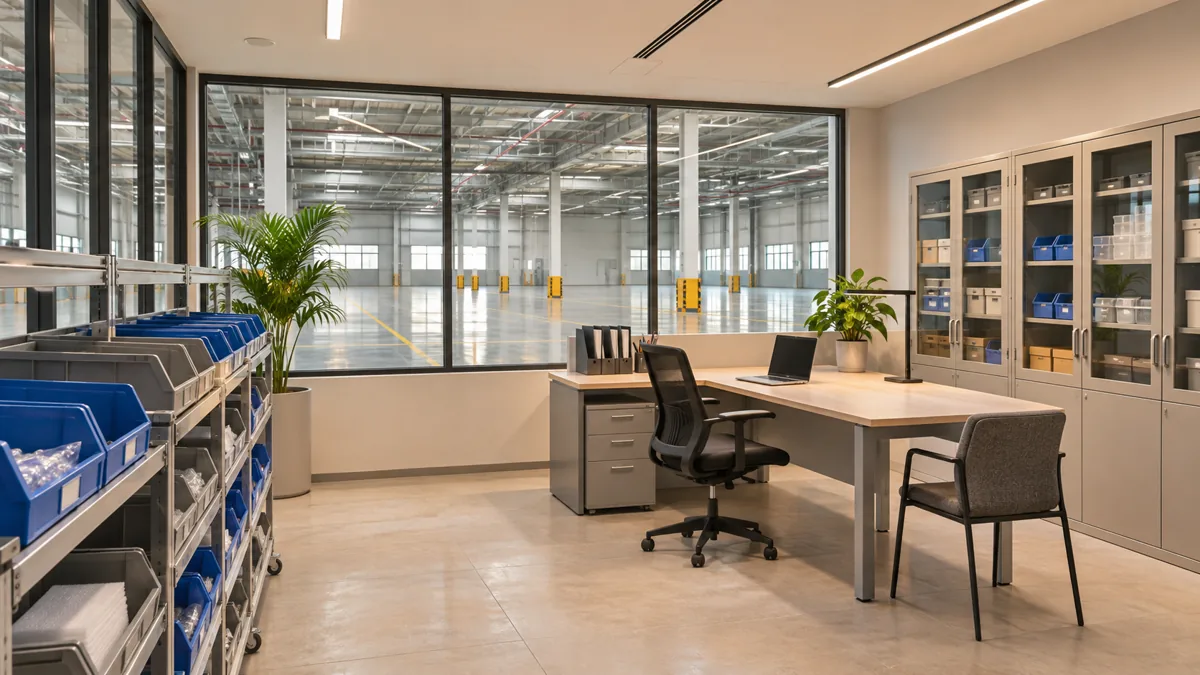
Factory Production Support Interior Design — interior design concept.
A production line can have the right machinery while its support work occupies every nearby surface. The next kit waits beside the current order, yesterday's instructions remain on a board, and a supervisor borrows a packing bench to resolve a missing part. These problems are often treated as housekeeping. They can instead reveal that the interior brief omitted the handoffs around production.
The useful starting point is one product order moving through its support tasks. Identify where people prepare materials, obtain instructions, exchange tools and resolve exceptions. Process engineers and other qualified specialists remain responsible for production design and technical requirements; the interior brief must connect their accepted decisions to usable places.
Jump to a section 11 topics
Define the support work that belongs in the fit-out
List activities by task rather than department name. Production control might include issuing an order, checking its documentation and coordinating a changeover. Material support might involve assembling an approved kit or returning unused items. Each creates a different need for surfaces, storage and communication. A label such as production office cannot explain all of those requirements.
Have the production lead distinguish work performed on the line from work prepared elsewhere. Do not move an activity simply because an adjacent room looks convenient. The responsible technical and safety advisers should assess its suitability and required relationships. The designer needs an accepted operating description, including what must remain close and what can use a shared support position.
Use the warehouse office fit-out guide for a separately occupied office enclosure. This factory brief concerns support that interacts directly with production orders, especially where information or materials change status at the boundary.
Measure the kit that reaches the production position
Ask the operator to provide representative handling units: trays, bins, cartons, carriers or another approved format. Record the assembled kit, empty carrier and any associated documents. A shelf measured from loose components can overstate its usefulness if the actual production kit travels in a larger container with a fixed orientation or identification method.
Follow receipt into the support position and the completed kit towards production. Who confirms that it is ready, and where does it wait before collection? The production and inventory teams should define the release process. The design should provide the corresponding physical positions without deciding which parts are suitable or which checks the manufacturing process requires.
In a hypothetical assembly business, one tray contains the current order while another holds an incomplete next order. If both occupy the only clear bench, a missing component can stop preparation for everything else. Compare a dedicated incomplete-kit location with scheduled preparation or another reviewed arrangement; do not assume a larger worktop is the only response.
Draw changeover with the previous order still present
A changeover drawing should include the outgoing materials and tooling, not only the attractive incoming setup. Ask the process owner to describe its approved sequence. Identify the objects that temporarily coexist and the roles moving them. The fit-out team should support that sequence without proposing machine procedures, technical isolation methods or unreviewed handling arrangements.
Try a labelled planning example with four statuses: current work, next work, returned items and an unresolved kit. These labels illustrate a comparison, not a prescribed factory system. The operator should choose its own statuses and authorisation. Draw the real carriers in each position and ask whether the person collecting the next kit can understand which one it is.
Compare fixed staging bays with a mobile support arrangement using actual equipment information. Fixed bays may make locations clearer; mobile equipment may suit a variable product mix but require parking and ownership. The useful choice includes how the emptied carrier returns, rather than ending when materials first reach production.
Give instructions one current place to be read
Identify the information a person needs at each support task. An order reference, drawing revision, visual example and general staff notice have different purposes. The production owner should establish the authoritative source and information controls. The designer should coordinate display and working positions so staff are not forced to infer priority from whichever sheet has been pinned most recently.
Mock up a document change with fictional order data. Ask an unfamiliar authorised colleague to find the current instruction and identify what remains unresolved. If that requires asking the person who last used the bench, the information arrangement is incomplete. The answer may concern naming, document control or screen configuration as much as cabinetry.
Keep approved sample pieces distinct from ordinary material and rejected examples. Their status belongs to the production or quality system. The interior can provide identified locations and appropriate protection based on the owner's requirements. A sample's physical presence should not become an implied instruction to copy it without understanding its reference and limitations.
Separate tool availability from tool storage
Ask which tools belong permanently to a position, which are shared and which require another professional control. The operator and relevant specialists should determine issue, inspection and use arrangements. The designer should understand the complete tool set, including cases and accessories, rather than calculate storage from the principal item alone.
Follow one shared tool through collection, use and its authorised return. Who confirms that it is available for the next task? If a provider visit or review is pending, where does the item wait under the operator's process? A rack that mixes several statuses can create confusion even when its physical capacity is adequate.
Discuss duplication as an operating decision. A second set may reduce waiting but create another support obligation; sharing may be appropriate if timings align. Compare both with the actual order sequence. Do not buy more identical cupboards before establishing whether the constraint is space, availability, a missing accessory or an unclear return responsibility.
Locate supervision where decisions can be made
A supervisor may need to observe a handoff, consult an order and hold a short conversation. Those actions do not necessarily need a full office beside every line. Ask which decisions require direct observation and which can happen at another agreed position. The answer should follow the work rather than a preference for a prominent glazed room.
Test the intended view from the actual working position with storage and equipment present. A standing sightline on an empty plan may disappear behind the day's carriers. Relevant specialists should assess environmental and safety requirements for the proposed location. An interior observation alone cannot establish that a position is suitable for occupied work.
Keep the discussion position from consuming the kit-preparation surface. In an illustrative review of a delayed order, two people may need a screen and documents while another colleague continues preparing material. A modest separate position can support both tasks more reliably than repeatedly clearing the main bench whenever a decision is needed.
Give exceptions an owner before giving them a shelf
Name the decisions that commonly interrupt support work: a missing component, uncertain order information, a supplier query or a carrier awaiting collection. The relevant production and quality leads should establish the authorised response. The design brief should identify the holding and communication provision that response needs, without turning the support room into an unreviewed repair or testing area.
Use a fictional incomplete kit to trace the escalation. Where does the coordinator record the query, who answers it and what tells the next shift that no release has occurred? Keep physical and digital references consistent. A note left on a carton may be insufficient if the system shows another location or status.
Where the decision requires inspection, testing or rework, brief that activity separately with competent advisers. The quality inspection area guide addresses that distinct function. Preserving the boundary prevents an ordinary preparation bench quietly acquiring technical duties that were never assessed or priced.
Price the complete support position
Describe the installed outcome across furniture, technology and specialist packages. A bench supplier may exclude device mounts; IT may exclude physical connections; a process-equipment supplier may assume another contractor provides supports. Identify the actual interface and its responsible designer before calling a position complete. Small exclusions can determine whether staff can use it.
For an illustrative order-release station, compare these purchasing boundaries:
| Item | Question before order | Useful evidence |
|---|---|---|
| Display and scanner | Who supplies, configures and mounts them? | Selected equipment and coordinated detail |
| Kit carrier | Does the stored configuration match the working kit? | Representative loaded carrier |
| Support bench | Which fixtures and service interfaces are included? | Complete package boundary |
Obtain technical information from the actual suppliers and have qualified designers assess it. The commercial fit-out scope should connect those accepted requirements to construction, rather than imply that an interior appointment replaces process engineering or specialist acceptance.
Choose flexibility against a named product change
Select a credible future change with the production lead. It might involve another carrier size, an additional order-document step or a different shared-tool arrangement. Compare its effect on the support position using actual information. An adjustable shelf provides one kind of flexibility; it does not establish capacity for another process, load or technical activity.
Ask what can be changed by authorised staff and what requires a supplier or professional review. Record the permitted configuration and any parts stored for that purpose. Mobile furniture is useful when the operator can move, reconnect and manage it appropriately. Its ability to roll does not make every future location suitable.
Evaluate the current operation before reserving excessive future space. The investor should understand which task a proposed allowance enables and what work remains later. A defined option can be valuable, while a vague expansion zone may simply displace the support that makes the opening production plan workable.
Accept the handoff with an unfamiliar authorised user
After relevant installation and specialist checks, follow one fictional order through preparation, instruction, release and carrier return. Include an exception and the shift handoff. Ask a nominated colleague unfamiliar with the design discussions to locate the current information and distinguish the operator's statuses. Their questions often expose assumptions that regular workshop participants stopped noticing.
Record physical conflicts separately from operating decisions and missing technical evidence. Assign each to the role able to resolve it. The review should establish whether the support arrangement works within its accepted scope, rather than certify the production process from a walkthrough. Retain its limits alongside the result.
Keep the final support layout linked to the carrier inventory, equipment references and current operating brief. When the product mix changes, these records explain why a surface or apparently empty position was preserved. The next decision can then address a real new requirement instead of gradually filling every gap around the line.
Distinguish trial material from released production work
A temporary engineering trial can introduce objects that resemble an ordinary kit but have a different status. Ask the process and quality owners how those materials are identified, where they wait and who authorises their next use. The support layout should provide the reviewed destination without suggesting that a spare production carrier makes an experimental activity suitable for the line.
For a hypothetical packaging change, a team brings sample inserts to compare with the current product. One set belongs to an authorised trial; another is the released production version. Ask an unfamiliar colleague to distinguish them through the operator's approved information. If the only difference is a verbal explanation, improve the identification and allocation before either occupies the normal kit-preparation position. The designer should support that distinction while the responsible technical team controls the trial.
Frequently asked questions
Is factory support design the same as production-line design?
No. This brief concerns the places supporting orders, materials, documents and shared resources. Process engineering, machinery requirements and technical safety remain with appropriately qualified specialists.
What should a factory interior design company receive first?
Provide a representative order journey, carrier dimensions, support-task list, current process layouts and supplier information. Identify the people authorised to confirm production and technical requirements.
Can one bench support preparation, inspection and rework?
Only after the responsible teams define and review each proposed activity. Do not treat a spare surface as evidence that additional technical work is suitable.
How should a factory interior design consultant compare layouts?
Use the same order, carriers, staff roles and exception in both. Include changeover and return tasks, then identify the first task each arrangement cannot support.
Plan your commercial and industrial interiors project with one accountable team
CBD Projects LLC provides interior design and fit-out coordination across Dubai and the UAE. Share your space, location, target opening date and budget range for a practical first review.
Send Your Project BriefBack to BlogRelated ServiceView Real ProjectsContact CBD Projects